
 0
0  Login
Login 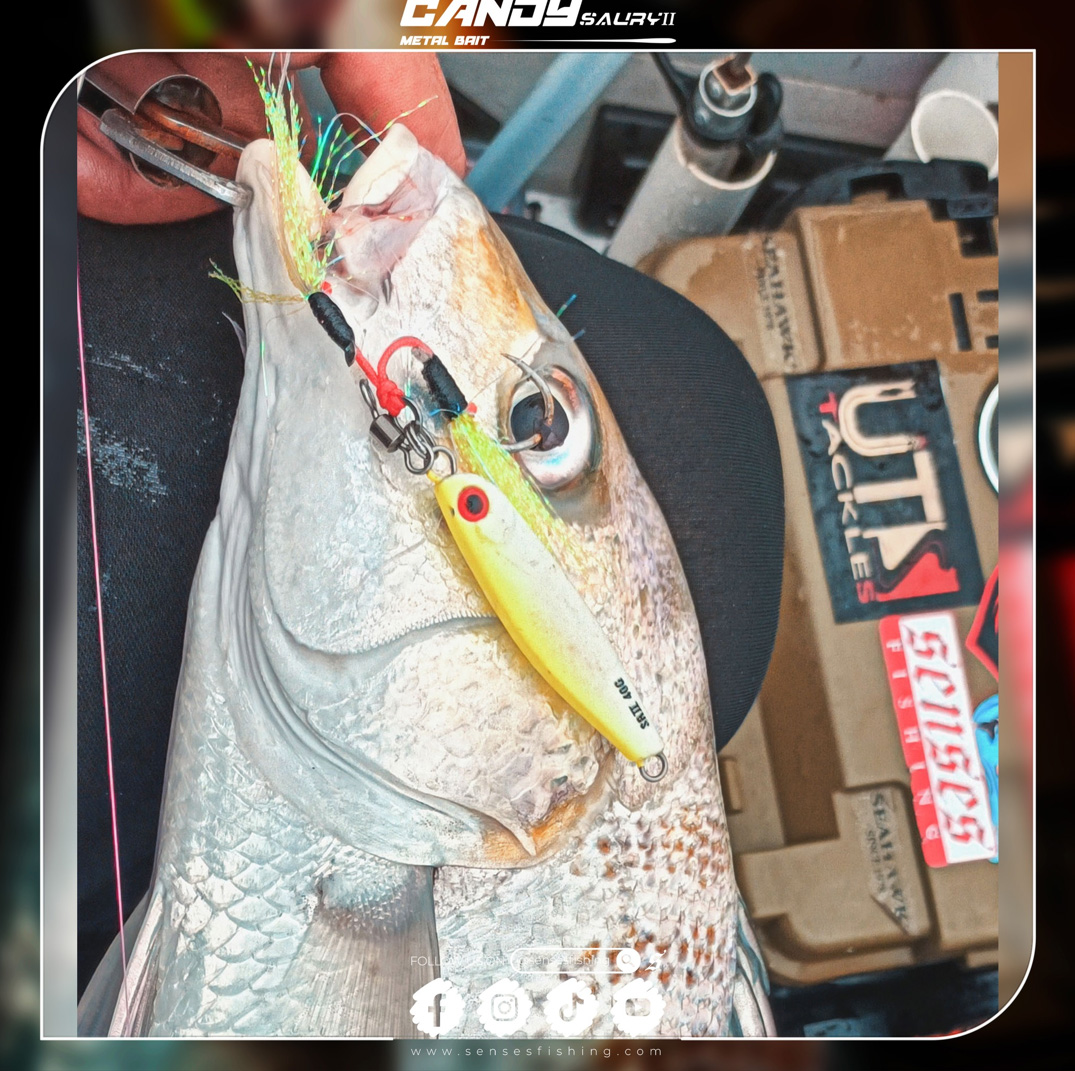

Bronze Beauty from the Deep 🐠
There is an undeniable aura of power surrounding the Golden Snapper, a species revered by anglers for its brute strength and its "take no prisoners" attitude once it hooks up. In this stunning showcase, Senses Pro Angler Mat Fared demonstrates the absolute lethality of the Senses Candy Saury II when navigated through the complex underwater topographies where these bronze titans dwell. The Candy Saury II is not just another metal bait; it is a precision-engineered tool designed with a specific weight distribution that allows it to slice through heavy vertical currents, reaching the dark crevices of the reef where Golden Snappers lie in wait. Its erratic, shimmering action on the fall mimics the panicked vibrations of a dying baitfish, a visual and sensory siren song that these ambush predators find impossible to ignore. For a fish that relies on a split-second strike to dominate its territory, the high-reflectivity finish of the Saury II provides the perfect target, even in the low-light conditions of the deep offshore drop-offs.
Taming a Golden Snapper of this caliber is a high-stakes game that demands a rod capable of extreme technical performance. Mat’s choice of a Senses rod provides the critical bridge between the angler and the lure, offering a sensitive tip that transmits the faint "tick" of a snapper inspecting the jig, followed by a massive reserve of power in the butt section to stop the fish’s desperate dive toward sharp coral structures. The technique used here—a combination of slow-pitch fluttering and sudden high-speed lifts—requires a rod blank with a fast recovery rate to keep the jig’s action crisp and enticing. This catch is a testament to the synergy of elite equipment: when the raw lifting power of a Senses rod meets the irresistible flutter of the Candy Saury II, the result is a golden trophy and an unforgettable story of man versus nature. If you’re serious about upgrading your saltwater game and targeting the kings of the reef, this setup is the definitive blueprint for success. 🎣✨🚤


The Golden Snapper 🐟
1. Distinctive Features
• The "Fingermark": Its most famous feature is the prominent dark spot located on the upper back, near the lateral line. Legend says it looks like a thumbprint, giving it the "Fingermark" name.
• Golden Bronze Sheen: Unlike other snappers, they possess beautiful large scales that shimmer with a bronze or golden hue, which becomes even more vivid when they are pulled from deeper waters.
• Crushing Power: They have extremely powerful jaws and large canine teeth designed to crush hard-shelled prey like crabs and prawns, which makes them a "tackle-buster" for unprepared anglers.
2. Habitat & Behavior
• The Reef Fortress: Adult Golden Snappers are highly territorial and "structure-oriented." They love to hide in deep rocky reefs, sunken shipwrecks, and underwater caves. This is why Mat Fared has to be so precise with his jigging—you have to get the lure right into their "living room."
• Estuary to Ocean: While the juveniles often grow up in the safety of mangrove estuaries and muddy river mouths, the big "trophy" adults move offshore to deeper reef systems (up to 80 meters deep).
• Nocturnal Hunters: They are most active during low-light conditions—dawn, dusk, or night—but can be triggered into a "reaction strike" during the day using high-flash lures like the Senses Candy Saury II.
3. The Angler's Challenge
• The "Dirty" Fighter: The Golden Snapper is notorious for its first run. The moment it feels the hook, it will immediately dive for the sharpest rocks or barnacle-encrusted pylons to cut your line.
• The "Click" Sound: Interestingly, when brought on board, they often make a distinctive clicking or "drumming" sound by vibrating their swim bladder, almost as if they are complaining about the fight!
To help you land more of these bronze beauties, here are the details on the best timing, along with an expanded long-form caption that ties it all together.
🌓 The "Golden Hour": Timing and Tides
• The Tide Factor: Golden Snappers (Fingermark) are most active during the slow-moving tides—the periods just before and after the tide turns (slack water). Too much current makes it hard to keep your Candy Saury II in their strike zone, while too little current stops the "food" from drifting by.
• Low-Light Dominance: They are primarily nocturnal or crepuscular hunters. The best time to jig for them is early morning (dawn) or late afternoon (dusk). Their large eyes are designed to see in the dark, giving them a massive advantage over baitfish when the sun is low.
• Moon Phases: Many pro anglers like Mat Fared find that the days leading up to the New Moon or Full Moon provide the strongest feeding windows, as the increased water movement pushes more bait towards the reefs.

🎣 Technique: The "Short Pitch" & "Reaction Fall"
The Golden Snapper is an ambush predator, meaning it won't often chase a lure for long distances. You have to bring the fight to them.
• The Technique: Use a Short-Pitch jigging motion. Instead of long, sweeping pulls, use quick, half-turns of the reel handle combined with small rod flicks. This keeps the Senses Candy Saury II dancing right in their face (the "Strike Zone") for a longer duration.
• The "Kill" Pause: Most strikes happen on the drop. After 5–7 quick pitches, let the jig fall on a semi-slack line for two seconds. The Saury II's "flutter" mimics a stunned baitfish, which is when the Snapper will inhale it.
• The Hookset: When you feel the "thump," don't wait! Strike hard and immediately start winching. You need to gain the first 2–3 meters of line to keep the fish away from the rocks.
📍 The Place: Where to Find the Gold
Golden Snappers are residents of high-structure environments. They don't wander aimlessly; they stay where they feel safe.
• Structure is King: Look for deep-sea pinnacles, sunken shipwrecks, or jagged rocky drop-offs.
• The "Up-Current" Side: Position the boat so your jig falls on the side of the reef where the current is hitting. Snappers sit there waiting for the water to push food (shrimp and small fish) directly into their mouths.
• Depth: In coastal waters, look for depths between 20m to 60m. The bigger, older "Grandfather" Snappers usually hold in the deeper, darker sections of the reef.
⚙️ The Equipment: Senses Pro Setup
You cannot bring "average" gear to a Fingermark fight—they will break it.
• The Jig (Senses Candy Saury II): Its slim, "Metal Bait" profile is essential for high-current areas. It sinks fast and offers less resistance, allowing you to use lighter weights while still reaching the bottom effectively.
• The Rod (Senses Pro Series): You need a rod with a fast action tip for jigging sensitivity, but a high-tonnage carbon backbone. The rod must be able to "lock up" when the fish tries to dive into a hole.
• The Terminal Tackle: Use a high-quality fluorocarbon leader (40lb–60lb). Since these fish have crushing jaws and live near sharp rocks, abrasion resistance is non-negotiable.
Diamond Trevally / Ikan Cermin

Diamond Trevally (Alectis indica)
Physical Characteristics
• Body Shape & Profile: It features a highly compressed, "diamond-shaped" body with a near-vertical, angular head profile. As the fish matures, the forehead becomes increasingly steep and blunt.
• Mirror-Like Finish: Its skin is covered in tiny, deeply embedded scales that create a brilliant silvery-mirror effect. In the water, it often displays an iridescent blue-green or bronze glow on its upper back.
• Fin Development: While your catch is an adult, the species is famous for the long, thread-like filaments on the dorsal and anal fins of juveniles. These filaments shorten as the fish grows, leaving behind the powerful, swept-back fins seen in your photo.
• Mouth & Teeth: Unlike the aggressive Giant Trevally, the Diamond Trevally has a relatively small, protrusible mouth with weak villiform teeth, indicating a diet of smaller, softer prey.
Biological Behavior
• The "Jellyfish Mimic": Juveniles use their long fin filaments to mimic jellyfish, providing camouflage from predators in the open water column.
• Feeding Style: They are opportunistic bottom and mid-water feeders. They use their specialized mouths to suck up small fish, squids, and crustaceans (crabs/shrimp) from the sandy seabed or around reef edges.
• Social Habits: While they are often solitary as large adults, sub-adults and mid-sized individuals frequently school around deep structures or over sandy flats.
• Fight Style: Known for their "flat" fighting style. Because of their deep body shape, they will turn their side toward the angler, using the water's resistance like a kite to make themselves feel much heavier than they actually are.
Habitat and Depth
• Versatile Environments: The Diamond Trevally is highly adaptable. It is commonly found in coastal waters, shipwrecks, and deep coral reefs, but it is also one of the few trevallies that enters estuaries and silty harbors.
• Depth Range: They occupy a wide range from shallow 5m flats to offshore depths of 100m.
• Substrate Preference: They prefer the "interface" areas—where a rocky reef or shipwreck meets a sandy or muddy bottom, as this is where their favorite crustacean prey lives.
Tips and Techniques
1. The "Flutter and Pause" Jigging Strategy Since you are using a light-jigging setup, focus on the "slow" side of the spectrum.
• Rhythmic Lifts: Use a medium-speed rhythmic lift (Slow Pitch style). Diamond Trevally are attracted to the flash of the jig, so a jig with a high-shine or holographic finish (like your silver/green jig) is essential.
• The "Stay" Zone: They often strike when the jig is fluttering back down. If you see a school on the sonar, keep your jig hovering 2–3 meters off the bottom.
2. Specialized Gear Requirements
• Light Drag: Because they have "soft" mouth membranes compared to other jacks, a drag that is too tight can tear the hook out. Use a smooth, moderate drag setting.
• Fluorocarbon Importance: Even though they have small teeth, they often feed near sharp structures. A 30lb–40lb Fluorocarbon leader provides the invisibility needed for their keen eyesight while offering abrasion resistance.
3. Best Timing & Location
• Tidal Flow: They are most active during the middle of the incoming tide when the current brings baitfish and crustaceans off the sandy flats.
• Structure Choice: Look for "isolated" structures. A single rock or small wreck on a vast sandy plain is a magnet for Diamond Trevally.
⚙️ Recommended Equipment
• Rod: Senses Golden Blue
This rod is specifically tuned for "Light Jigging" with a heavy backbone. It features X-Factor carbon technology, allowing you to flick the jig with finesse while providing the lifting power needed to "peel" a Grouper off the sea floor.
• Main Line: Senses Mojiko
A slightly thicker PE 2.5 provides extra security against abrasion. It has zero stretch, ensuring that every "tick" on the jig is felt instantly by the angler.
• Leader: Senses Absorber (50lb - 60lb)
Both Snappers and Groupers have abrasive mouths and live near razor-sharp barnacles. This high-diameter fluorocarbon is your insurance policy against "break-offs" during the first 10 seconds of the fight.
• Lure: Senses Metal Jack (60g - 100g)
While the Candy Saury II is slim, the Metal Jack has a wider body. This creates a slower, more aggressive "leaf-fall" action that is irresistible to Orange-Spotted Groupers who prefer a bigger, slower-moving target.
Spotted Sicklerfish / Ikan Daun Baru or Bebaru

Spotted Sicklefish (Drepane punctata)
• Appearance: It has a deeply compressed, oval-shaped silvery body.
• Coloration: Its body is marked by 5 to 10 series of small black spots arranged in vertical lines on the upper half. It also features a highly protrusible mouth that forms a downward-facing tube.
• Fins: Long sickle-shaped pectoral fins that extend to the tail.
• Behavior: A bottom-feeder that consumes small benthic animals found in the substrate.
• Habitat: They occur in tropical coastal waters over sand or mud bottoms, including reefs, estuaries, and harbors. They are typically found at depths between 10 and 49 meters.
Coastal Trevally (Onion Trevally), Rod Senses Golden Blue PE 0.6-1.5

Coastal Trevally (Onion Trevally) – Carangoides coeruleopinnatus
• Identification: Recognized by its blunt, steep head profile (nearly vertical above the mouth) and a very deep, strongly compressed, ovate body.
• Coloration: Bluish-green on the back fading to silvery-grey; the sides are distinctively marked with numerous small yellow-orange spots. There is a small dark blotch on the upper margin of the gill cover.
• Fins: Unlike the Bluefin, its fins are generally dusky to pale yellow. Juveniles are known for a long, thread-like filament on the second dorsal fin that shortens as they mature.
• Habitat: Adults are rarely found close to shore, preferring deep coastal reefs and sandy areas between 30m and 100m depth. They are often solitary or move in very small groups.
• Technique: Highly responsive to light jigging and micro-jigs (like the one in your photo). Since they have relatively soft mouths and weak teeth, a lighter drag setting is recommended to avoid pulling the hook during the fight.

The SENSES Candy Metal bait - Saury II is a versatile fishing jig suitable for both saltwater and freshwater environments. Its balanced body design provides a wobbling swimming action, optimizing casting distance and attracting predatory strikes. Crafted with durable metal alloy and various metals, the SAURY II mimics a wounded baitfish, alluring fish in any water type. The use of hot iron-pressed paint ensures long-lasting color durability, while its fluttering and darting actions consistently provoke fish strikes. Tested and proven to catch numerous saltwater fish species, the SAURY II is a well-designed and reliable choice for anglers seeking success in their fishing adventures.

The SENSES Metal Jack Jig - the ultimate fishing companion designed to take your angling experience to new heights! Crafted with cutting-edge features, this jig is sure to become your go-to choice for various fishing techniques. Constructed from high-quality metal alloy material, the SENSES Metal Jack Jig boasts unmatched durability, ensuring it can withstand the toughest of challenges while maintaining its performance. The hologram body adds a touch of allure, attracting fish from afar with its mesmerizing glimmer.
Versatility is the key highlight of this jig. Whether you're into micro and light jigging or prefer casting and retrieving, the SENSES Metal Jack Jig adapts effortlessly to every fishing style. With its unique design, one side flaunts an intricate fish pattern, while the other side resembling a squid adds an extra layer of intrigue. The clever positioning of a big red-eye at the center confuses predator fish, dramatically increasing the hit rate.
The jig's surface treatment process ensures minimal flaws and superior painting, resulting in an impeccably smooth finish. This not only enhances its appearance but also contributes to its overall efficiency in attracting fish. Whether you're targeting fish at the top, middle, or bottom of the sea, the SENSES Metal Jack Jig is designed to excel in any fishing spot.
Unleash the potential of your fishing expeditions with the SENSES Metal Jack Jig and experience the thrill of breaking your personal target fish records. Don't miss out on the chance to elevate your fishing game and make every fishing trip a memorable success!
Click on any of the items listed below to find out more on the product page:
Angler: Senses Pro Angler Mat Fared
Jig: • Senses Candy Saury II