
 0
0  Login
Login 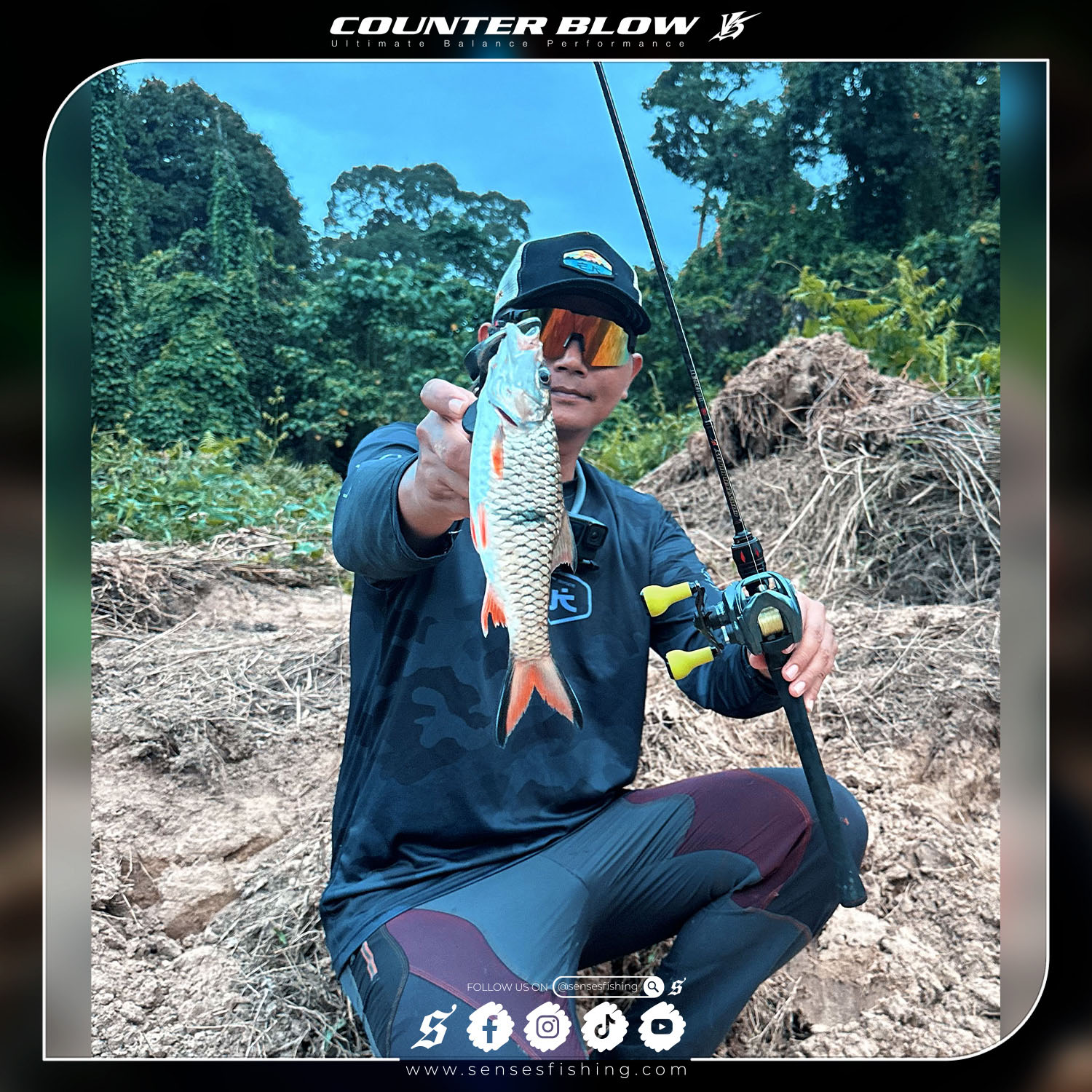

Tactile Feedback in the Wilds🌲
Jungle trekking to find the perfect fishing spot is a test of endurance, and Senses Pro Angler Mohd Faizal Mohd Nor needs gear that is as tough as he is. The Senses Counterblow V3 is built for the rugged reality of Malaysian angling—light enough to carry for miles through thick brush, yet durable enough to withstand the "accidental" knocks that happen in the wild. Its ergonomic design ensures that even after 1,000 casts in a single day, the angler’s wrist remains fresh and ready for the one strike that matters. This is professional-grade equipment for those who don't believe in "quitting."
The lure that sealed the deal, the Senses Saviors 50S, is built with the same philosophy of durability. Its high-quality finish and reinforced bib mean it can bounce off rocks and submerged logs without losing its action. Faizal’s strategy today was "contact fishing"—deliberately banging the Senses Saviors 50S against structure to create noise and flash. This aggressive technique requires a rod with a sensitive enough tip to distinguish between a rock and a fish, a feat the Senses Counterblow V3 performs effortlessly. When the "rock" started swimming away, Faizal knew he had a trophy on the line. Another successful day in the office for a Senses Pro. 🎒🌲💪


The Fish: Hampala Barb (Hampala macrolepidota)
Commonly known in Southeast Asia as the Sebarau or Jungle Perch, is the largest and most aggressive member of the Cyprinidae family.
1. Physical Characteristics: The Golden Hunter
• Head and Mouth: The Sebarau (Hampala macrolepidota) is equipped with a large, terminal mouth and a highly protrusible jaw system. While it lacks teeth in its jaws, it features a powerful "vacuum" grip capable of inhaling prey whole. Its most lethal weapon is its massive jaw gape and strong pharyngeal bones in the throat, used to crush slippery prey like river rasboras and crustaceans during the high-speed inhale.
• Coloration and Markings: Depending on age and water clarity, its scales range from a brilliant metallic silver to a deep coppery-bronze. Mature specimens in jungle streams often exhibit a vibrant black vertical bar across the midsection. Their fins, especially the caudal and pelvic fins, display a fiery orange-red hue, acting as light-reflecting signals in the tea-colored water of the deep-sea-like river spectrum.
• Body and Fins: Built for high-velocity bursts, it has a sleek, torpedo-shaped body. Its broad, deeply forked caudal fin (tail) provides the massive torque needed to ambush prey in heavy currents and instantly retreat into razor-sharp submerged timber or rock crevices before an angler can react.
2. Habitat: The "Current-Master" of the Jungle Streams
• Benthic Environments: While juveniles inhabit the shallow, vegetated river margins, adults migrate to the upstream sections and deep river pools. They are commonly found holding tight to the "hard bottom" where the river floor transitions into granite boulders and limestone ledges.
• Ambush Zones: They are strictly structure-oriented. In the clear jungle waters, they utilize the "shadow lines" created by overhanging bamboo and underwater topography. They hang on the down-current side of eddies, waiting for the flow to sweep baitfish past their hiding spots.
• Water Quality: In the high-oxygen and pristine temperatures of the mountains, these barbs are highly sensitive to vibration. They rely heavily on their lateral line system to detect the mechanical "thump" of a lure through the dense, moving water column before they even see it.
3. Behavior and Equipment:
• The "Hit and Run": This predator is a lightning-fast hitter. It doesn't "taste" the bait; it snaps at it with explosive force and immediately turns its head back toward the reef-like snags. This "thump" gave the species its reputation for power and requires an angler to have an incredibly fast reaction time.
• Equipment Synergy: To counter this, Senses Pro Angler Mohd Faizal Mohd Nor uses a high-performance finesse setup. The Senses Counterblow V3 rod provides the backbone to stop the run, while the Senses Saviors 50S is the primary weapon; its center-balanced, sinking body is designed to flutter horizontally on the drop, maximizing the "flash" that mimics a dying baitfish.
• Technique: Faizal utilizes an aggressive "twitch-and-pause" cadence. The Saviors 50S's realistic eye acts as a strike point, confusing the Sebarau and ensuring the treble hooks find purchase in the hard, bony jaw rather than being spat out during the frantic initial strike 🎣.

Tips & Technique
1. The Environment: "The Current King"
In Malaysia and across the Indo-Pacific, the Hampala Barb is the ultimate prize for freshwater river and highland stream anglers.
• Structure: They live in the "white water" zones—specifically submerged timber (reba), granite boulders, and deep limestone ledges. If you aren't casting your Senses Saviors 50S into the heart of the rapids or against the edge of a snag, you aren't fishing for big Hampala.
• Water Flow: The best time is during high oxygenation periods, specifically when the river is "running" but not flooded. Focus on the eddy lines where fast water meets still water; this forces the fish into predictable "pockets" where they wait to ambush baitfish.
2. Equipment: Precision Power Finesse
Because a Hampala Barb hits with a bone-jarring "thump" and tries to dive into snags within the first two seconds, your gear must balance extreme sensitivity with high-torque stopping power.
• Rod: The Senses Counterblow V3 with a Fast or Extra-Fast Action. You need a crisp "recovery rate" to set the hook and a stiff "butt section" to stop the initial downstream run. A PE 0.6–1.2 or 0.8–1.5 rated rod is the professional standard.
• Leader: Hampala are visually sharp in clear water but have abrasive "crushing" jaws and live near sharp rocks. Use 12lb to 25lb Fluorocarbon to maintain invisibility while providing enough abrasion resistance for jagged granite environments.
• Drag Settings: Set your drag firm but smooth. Unlike the Jack, the Hampala uses the current's force to its advantage. You must keep the head turned toward the open water immediately to prevent the fish from "reefing" you in submerged roots.
3. Technique with the Senses Saviors 50S
The Senses Saviors 50S is a "heavy-sinking" minnow, which is perfect for cutting through heavy currents to reach the deep-dwelling territorial predators.
• The "Panic Strike": Cast upstream at a 45-degree angle. Use aggressive, short snaps of the rod tip. You want to make the Hampala think a small fish is struggling and darting erratically against the heavy flow.
• The "Stop-and-Flutter": When the lure reaches the deep "bucket" of a pool, stop your retrieve for a split second. The Saviors 50S is designed to shimmer on the drop; the Hampala often hits the lure during this brief pause as it perceives an "exhausted" baitfish.
• The Hookset: When you feel the violent "thump," strike instantly. The Hampala has a hard, bony mouth, so a sharp, upwards hookset is required to ensure the treble hooks find a solid hold before the fish headshakes.
4. Pro Tips for Hampala Barb
• Target the "V-Line": Always cast into the "V" shape formed where water flows between two rocks. This is the primary feeding lane where the largest specimens hold position.
• Check the Split Rings: Ensure the Senses split rings and hooks are high-tensile. The explosive strike of a 3kg+ Hampala can put immense pressure on standard terminal tackle.
• The "Flash" Factor: In clear highland water, silver or natural "Rasbora" patterns are king. In stained or "kopi-o" colored water after rain, gold-flanked or high-visibility chartreuse lures will outperform natural colors.

The Proper Time & Place
I. Time: The Diurnal Predator
Unlike the nocturnal Mangrove Jack, the Hampala Barb is primarily active during the day and relies heavily on high light levels to hunt.
• The "Golden Window": 07:00 AM to 10:00 AM. They are visual "burst" hunters that rely on the first light to spot the shimmer of baitfish against the river surface.
• Secondary Peak: 04:30 PM to 06:30 PM. As the sun begins to dip, they move out of deep-water "buckets" and patrol the shallow gravel runs to ambush fry settling for the evening.
• The "Noon Flash": On overcast days, a sudden burst of sunlight at midday can trigger a "frenzy" as the light reflects off the Senses Saviors 50S, making it visible from the deep.
II. Weather: The Clarity Factor
The Hampala Barb is a "spooky" species that is easily deterred by high-visibility conditions and surface disturbances.
• Ideal Condition: Overcast with a Light Drizzle. Total calm (glassy water) in the jungle allows the fish to see the angler. A light rain breaks up the surface tension, hiding your silhouette and making the fish bold enough to strike near the bank.
• The "Post-Storm" Rule: Avoid fishing immediately after heavy tropical rain if the water is "chocolate." However, as the water turns "Tea-Colored" (Kopi-O), the visibility is perfect—just enough for them to see the vibration and flash of the Saviors 50S without spotting the leader.
III. Place: The "Rapid-to-Pool" Transition
This fish is not a "still water" dweller. It thrives in high-energy zones where the river moves the most.
• The "Eddy Line": Focus on the 1m to 3m depth range. Specifically, look for areas where fast-moving rapids meet a deep, still pool.
• Submerged Timber (Reba): Large Hampala often patrol the edges of fallen trees. They sit on the down-current side, using the wood as a "pressure break" to conserve energy.
• Granite Boulders: In highland rivers, boulders create "pockets" of slack water. These are "Sebarau Magnets," especially when the boulder is located in the middle of a heavy current.
IV. Tide: The Hydraulic Push
Freshwater systems rely on "Hydraulic Flow" rather than lunar tides. Movement is essential; as the saying goes, "No run, no fun."
• The "Sweet Spot": The first 24 hours of a Rising Water Level. A slow, steady rise brings fresh nutrients and "washes" insects and smaller barbs into the main channel.
• Dropping Water: This is often the worst time; as the water recedes, the fish become cautious and retreat into the deepest, most inaccessible holes.
• Flow Velocity: Aim for Medium-Fast flow. If the current is too strong (Flash Flood), it is difficult to keep your Senses Saviors 50S stable in the strike zone, which is essential for the "twitch-and-stop" technique.
Pro Tip: Look for the "V-Slicks" on the water surface caused by submerged rocks. Cast your Senses Saviors 50S exactly 2 meters upstream of the "V" and let the current sweep the lure into the rock's shadow. The moment the lure enters the slack water, give it two sharp twitches—this is the "Strike Zone" where a territorial Hampala will smash the lure to protect its feeding lane! 🎣🔥
Recommended Setup
To target the Hampala Barb (Sebarau) in its high-energy river habitat without using standard sinking minnows, you need high-torque gear capable of extraction and finesse to manage the violent impact of a current-driven strike.
1. The Rod: Senses Viking - Finesse Casting Series
> Since we are moving away from the Counterblow, the Senses Viking is the premier alternative for finesse jungle casting. It offers a crisp, high-carbon recovery that is essential for accurate casting in tight, overhanging river structures. Its backbone is specifically tuned to "stop" a fish from reaching the roots without sacrificing the sensitivity needed for small lures.
2. The Lure: Senses Saviors 52SD (Sinking Deep)
> The Senses Saviors 52SD is a distinct evolution designed for deeper "plunge pools" and upstream waterfalls where the 50S lacks coverage. Its extended lip design allows the lure to dive deeper and stay in the strike zone longer against heavy vertical currents.
• Alternative Lure: Senses Kaido Shad 65HS (Heavy Sinking)
> For larger river channels or the "main rapids," the Kaido Shad 65HS provides a larger profile and heavier weight (HS), allowing for maximum casting distance and a stronger vibration that triggers the territorial instincts of 3kg+ "monster" Sebarau.
3. Terminal Tackle & Lines
• Line: Senses Mojiko 150m (X8 Braid): A high-performance 8-strand braid featuring a super-smooth coating for friction-less casting. The 150m spool is perfect for finesse reels, providing the thin diameter needed to cut through heavy currents.
• Leader: Senses Absorber 100% Fluorocarbon (20lb – 25lb)
> Specifically designed for clarity and abrasion resistance against granite rocks and submerged timber.
• Snap: Senses Banana Snap or ABX Diamond Snap
> The Senses Banana Snap is the standard for high-vibration lures. Its rounded profile allows the minnow to "hunt" freely without jamming the swimming action.
• Hook Upgrade: Senses Komodo VX4 Treble Hook
> Many anglers upgrade to the VX4 for its high-tensile strength, ensuring the hooks don't straighten during the violent head-shakes of a wild Sebarau.
4. Reel Maintenance: ABX High Speed Bearing Oil
> Constant casting in freshwater rapids requires high-performance reel maintenance. The ABX High Speed Bearing Oil ensures your spool stays fast for those long-distance "search casts" across the river.
5. The Apparel: Senses Jersey with Hoodie and Anti-UV Face Long Sleeve (Black Grey)
> Features 360-degree protection with an integrated face mask and hoodie to shield against intense UV glare and biting insects. The moisture-wicking fabric and stealthy Black Grey colorway are essential for long treks and approaching wary fish undetected.


♦ The SENSES Counterblow V3: Redefining Performance and Versatility ♦
The SENSES CounterBlow V3 is a highly sensitive baitcasting rod with a one-piece design, built for precision and durability.
Crafted with advanced Cross-X technology carbon tape in a multi-axis style, the CounterBlow V3 offers superior stability and exceptional handling in any fishing environment. Whether you’re targeting light strikes or preparing for a sudden big catch, this rod is designed to handle it all.
The SENSES CounterBlow V3 utilizes Fuji components. The Fuji Alconite K guide enhances casting performance, lifting power, and hook-setting efficiency, giving you better control with every cast. Unlike the V2, which uses the Fuji ACS reel seat, the CounterBlow V3 is now equipped with the Fuji PMTS reel seat, providing a more secure grip, improving sensitivity, and ensuring a better connection between you, the rod, and the fish.
The overall design features black, red, and gold accents, giving the CounterBlow V3 a noble and mysterious feel that enhances your fishing experience. It is also equipped with a new 3D SENSES logo plate at the bottom of the rod, adding a unique touch of style and elegance.
Each rod is specifically designed to meet the demands of today’s top fishing techniques, making casting effortless and offering the sensitivity to feel even the lightest strikes. The CounterBlow V3 is the perfect rod for any serious angler seeking ultimate performance.


In the waters of Malaysia, such as lakes and rivers, there is an abundance of smaller-sized fish. These fish can be effectively targeted using lures that trigger their instinct when provoked. The SAVIORS 50S lure is particularly well-suited for this scenario. With its excellent balance and dynamic action, the Saviors 50S can track and swim effectively even in strong currents, whether it be in upstream or downstream conditions. By retrieving the lure quickly and adding twitches, it mimics the movement of fast-fleeing baitfish. Despite its compact size of 50mm and weight of 6.5gms, the Saviors 50S can be casted far and wide. Additionally, its wobbling action during the drop further entices predators to attack the lure.
Click on any of the items listed below to find out more on the product page:
Angler: Senses Pro Angler Mohd Faizal Mohd Nor
Lure: Senses Saviors 50S
Apparel: • Senses Long-Sleeve Jersey - Blue Dragon
• Senses Fishing 10th Anniversary Ultron Jersey