
 0
0  Login
Login 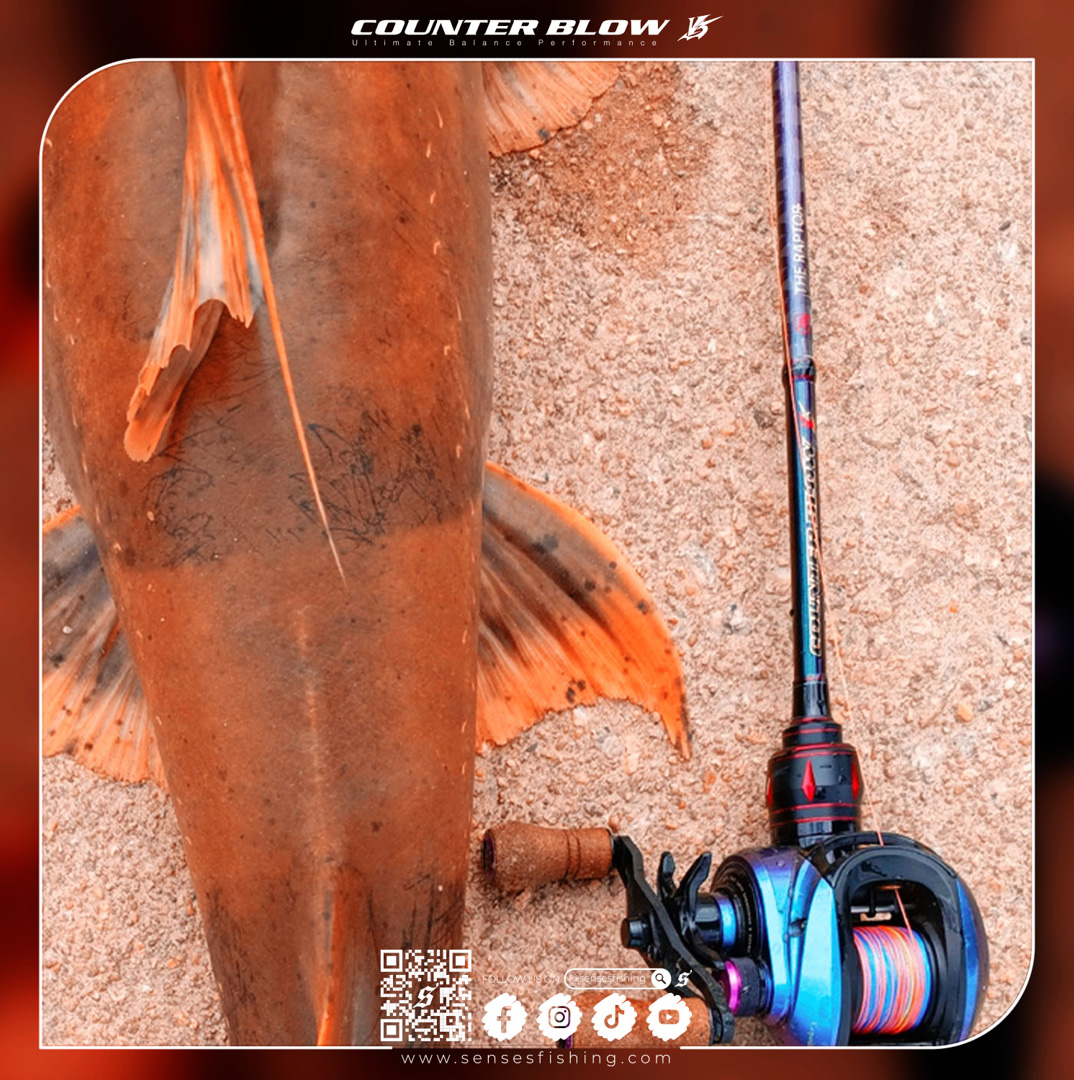

The Mystery of the Murky Outflow 🌫️
Deep within the turbulent discharge of the floodgates, a prehistoric shadow was waiting. Senses Pro Angler Mija Dik Jaa knew that to entice a Kenerak of this magnitude, he needed a lure with an aggressive profile and an irresistible "thump." He turned to the Senses Nano Shad 65f, a lure designed to hold its track even in the heaviest currents. As the lure vibrated through the murky depths, it crossed the path of this apex predator. The strike wasn't just a bite—it was a violent ambush that tested the limits of the Senses Counterblow V3. This rod is legendary for its ability to absorb high-impact strikes while maintaining the backbone needed to stop a fish from diving into the sharp concrete pilings.
The battle was a masterclass in tension management and gear reliability. Wrestling a Goonch catfish in such a high-risk area means there is zero room for equipment failure. The Senses Mojiko line provided the essential abrasion resistance, brushing against the rough structures as the fish tried to roll and pin itself to the bottom. Connecting the lure to the line was the Senses MG Snap, which held its shape perfectly under the immense crushing force of the catfish’s mouth. This catch proves that when you combine the technical expertise of a pro like Mija with the precision engineering of Senses gear, even the most elusive river monsters can be conquered. 🏆🔥


The Goonch catfish (Bagarius genus) is one of the most distinctive and formidable predators in Southeast Asian rivers. Often called the Ikan Kenerak or Giant Devil Catfish, it is a fish that looks as though it belongs in the prehistoric era.
1. Physical Characteristics: The River Gargoyle
• Head and Mouth: The Goonch catfish has a massive, flattened "bulldog" head with a wide, crescentic mouth. Inside, it possesses multiple rows of heterodont teeth—the outer rows are small and close-set, while the inner rows feature large, widely separated conical "fangs" designed to grip and crush prey.
• Body Armor & Skin: Unlike many catfish that are smooth, the Kenerak’s skin is thick and leathery, covered in small, rough, bony elevations (tubercles). It lacks scales, instead relying on a heavy mucus layer and its "armored" feel to protect it against the jagged rocks of its habitat.
• Coloration: Its body is perfectly camouflaged for river bottoms, featuring a mottled pattern of tan, grey, and dark brown with irregular black bands. This allows it to blend into the shadows of concrete structures or rocky riverbeds.
• Fins: It has large, wing-like pectoral fins which it uses to "pin" itself to the river floor. These fins help it stay stationary in heavy currents without using much energy.
2. Habitat: The "Current-Loving" Predator
• Turbulent Waters: The Goonch catfish is a rheophilic species, meaning it thrives in fast-flowing, oxygen-rich water. It is almost always found in the main channels of large rivers, particularly in areas with heavy rapids or turbulent outflows like the floodgates shown in your image.
• Benthic Lurkers: As a bottom-dweller (benthic), it spends most of its time in deep pools located immediately behind fast currents or eddies. They are notorious for "locking" themselves between boulders or concrete pilings, making them feel like a heavy snag when first hooked.
• Water Quality: They prefer slightly alkaline water ($pH$ 7.0 – 8.0) and are highly sensitive to low oxygen levels. This is why you often find them near man-made structures like dams and gates where the water is constantly aerated by the splashing fall.
3. Behavior and Diet
• Ambush Hunting: The Goonch catfish is a patient hunter. It uses its long maxillary barbels (whiskers) to detect vibrations in the murky water. It stays perfectly still until a fish (or a Senses Nano Shad 65f) passes by, then strikes with a sudden, powerful lunge.
• Diet: They are opportunistic carnivores. In the wild, they feed on smaller fish, crustaceans (prawns), amphibians, and occasionally small land animals that fall into the river.
• The "Anchor" Fight: For an angler like Mija Dik Jaa, the challenge of the Kenerak is its defensive behavior. Once hooked, the fish will immediately try to dive into a hole or press its body flat against a rock or concrete wall, using its massive surface area and the current to become almost unmovable.

Pro Tips
1. The Fish: Understanding the Kenerak
The Goonch catfish is a "suction" predator with a massive surface area. Its fight isn't just about speed; it’s about dead weight and anchoring.
• The "Pinning" Behavior: When hooked, a Kenerak will use its huge pectoral fins to pin itself against the concrete floor or wedge its head into a crevice.
> Tip: If the fish feels like a "stuck log," do not just pull harder—you might snap your line. Give it a moment of slack to encourage it to move, then immediately apply heavy pressure with the Senses Counterblow V3 to lift it before it "locks" again.
• The Hard Mouth: Their mouths are bony and leathery.
> Technique: Use a sharp, upward "double-strike" hookset. You need to ensure the hooks of your Senses Nano Shad 65F penetrate past the thick skin.
2. The Place: Floodgates & Concrete Structures
The floodgate is a supermarket for Kenerak, but a nightmare for anglers.
• Target the "Slack Water" Edges: Kenerak rarely sit in the middle of the fastest "white water." They sit in the seams—the line where the fast water meets the slower water.
> Technique: Cast your lure into the fast current and let it sweep naturally into the slack water near the concrete walls. This is where the ambush happens.
• Abrasion Hazards: Concrete is like sandpaper for fishing lines.
> Tip: Keep your rod tip high during the fight. By keeping the Senses Mojiko line at a steep angle, you prevent it from rubbing against the sharp edges of the gate's apron or submerged debris.
3. The Equipment: Maximizing your Senses Gear
Using precise gear is the only reason this fish didn't break off.
• Rod: Senses Counterblow V3
> Technique: This rod has a high-recovery blank. When the Goonch catfish dives, use the "Pump and Reel" method. Lower the rod slightly while reeling quickly, then pull back slowly using the rod’s mid-section (the backbone) to lift the fish. Never "high-stick" (pointing the rod straight up) as it puts too much stress on the tip.
• Lure: Senses Nano Shad 65f
> Technique (The Slow Roll): Because Goonch catfish are bottom-dwellers, you must keep the lure deep. The Senses Nano Shad 65f is buoyant. If you feel it hit a rock, stop reeling for a second—it will float up slightly, avoiding the snag—then start reeling again. This "stop-and-go" movement often triggers the strike.
• Line: Senses Mojiko
> Maintenance: After a fight with a Goonch catfish near concrete, always check the last 2 meters of your Senses Mojiko line for frays. Even the best line can take damage from barnacles or concrete edges. If it feels rough, cut it and re-tie.
• Accessory: Senses MG Snap
> Security: The Senses MG Snap is essential here because Goonch catfish are "rollers." They twist their bodies violently during the landing. A standard snap might pull open, but the MG Snap’s locking mechanism is built to handle that rotational torque.
The proper time & place
1. Best Time: The Golden Windows
Goonch catfish are primarily crepuscular and nocturnal hunters.
• Dawn & Dusk: The absolute prime time is 6:30 AM – 8:30 AM and 6:00 PM – 8:00 PM. During low-light transitions, they move out of deep crevices to patrol the shallow edges of concrete structures.
• Night: If the floodgate is illuminated by artificial lights, Kenerak will linger just outside the light’s edge in the "strike zone," waiting for baitfish to be silhouetted against the glow.
2. Weather: Overcast & Active
• Cloudy/Overcast Days: This is the best weather for Goonch catfish. Because they have light-sensitive eyes, heavy cloud cover encourages them to feed throughout the day rather than just at dawn.
• Post-Rain (The "Tea" Water): Slight rain upstream that turns the water "teh tarik" (milky brown) is perfect. The turbidity hides your Senses Mojiko line and allows the vibration of the Senses Nano Shad 65f to do all the work.
• Avoid: High-pressure, bluebird sky days with zero wind. The fish become lethargic and retreat into deep shadows.
3. The Place: Hydrodynamic Hotspots
Don't just cast anywhere; look for energy breaks in the water.
• The Eddy Seam: Look for where the fast water from the gates hits the still water of the bank. This "seam" creates a conveyor belt of food.
• The Apron Lip: Most floodgates have a concrete "apron" that eventually drops off into a deeper riverbed. Position your lure to "fall" over that lip—Kenerak sit right at that drop-off point.
• Concrete Pilings: Any vertical structure that breaks the current provides a "flow refuge" where a Kenerak can sit without burning energy.
4. Tide: The Secret Engine
Even in freshwater rivers, many of Malaysia’s large river systems are tidally influenced (especially in Perak, Pahang, or Johor).
• Moving Water is Key: Never fish during "slack water" (the period between high and low tide when the water stops moving). Kenerak become inactive when the current dies.
• The Outgoing (Ebb) Tide: This is often the best tide. As the water level drops, baitfish are forced out of the vegetation and into the main channel, right past the floodgates.
• Incoming (Flood) Tide: Also productive, as it brings cooler, highly oxygenated water upstream, which "wakes up" the Kenerak’s metabolism.
Giant Knifefish / Ikan Belida Gajah


The Giant Knifefish (Chitala lopis) is one of the most enigmatic and visually striking species in our local waters. Often called the Ikan Belida Gajah, Great Knifefish or Asiatic Knifefish, it is a master of stealth and deep-water maneuvering.
1. Physical Characteristics: The Silver Blade
• Body Shape & Movement: The Giant Knifefish features an extremely compressed, knife-like body that tapers toward the tail. Unlike most fish, it moves using a long, undulating anal fin that allows it to swim both forward and backward with incredible precision.
• Skin & Coloration: It possesses a brilliant silver-to-bronze iridescent sheen. This metallic finish acts as a mirror in deep water, breaking up its silhouette from predators and prey alike.
• Head & Mouth: It has a distinct "humpbacked" profile and a large, cavernous mouth designed for suction feeding. Its eyes are relatively large, adapted for hunting in low-light or tea-colored river environments.
• Respiratory Adaptation: It possesses a specialized labyrinth-like organ that allows it to breathe atmospheric air. You will often see them "rolling" on the surface to gulp air, which is a key tell-tale sign for an angler.
2. Habitat: The Shadow Dweller
• Deep Structures: Unlike the current-loving Goonch catfish, the Giant Knifefish prefers slower-moving sections of large rivers, deep lakes, and submerged swamplands. It is almost always found near heavy cover, such as sunken logs, large boulders, or the steep rocky banks shown in the photo.
• Nocturnal Lairs: During the day, they retreat into deep "holes" or under thick overhangs where the light is dim. They are highly territorial and will stay in the same deep pool for long periods if the food supply is consistent.
• Low Oxygen Tolerance: Because they can breathe air, they often inhabit stagnant or slow-moving pockets of water where other predatory fish might struggle to stay active.
3. Behavior and Diet
• Crepuscular Predator: The Giant Knifefish is most active during the twilight hours of dawn and dusk. It uses its lateral line system to detect the micro-vibrations of prey, making it highly susceptible to the tight-action vibration of the Senses Nano Shad 65f.
• Diet: They are strictly carnivorous, feeding on a diet of small fish, freshwater prawns, and aquatic insects. They don't chase prey over long distances; instead, they drift silently until they are within "inhaling" range.
• The "Knife-Edge" Battle: For Senses Pro Angler Mija Dik Jaa, the challenge of the Belida is its unpredictable fight. They are famous for their "tail-walking" jumps and their ability to swim toward the angler to create slack line. Using the Senses Counterblow V3 is vital here to maintain constant tension and counter their sudden, erratic directional changes.

Pro Tips
1. The Fish: Understanding the Giant Knifefish The Giant Knifefish is a highly compressed, muscular predator that utilizes its unique anatomy to deliver a fight unlike any other river species. It combines the weight of a heavyweight with the agility of a gymnast.
• The "Knife-Edge" Maneuver: When hooked, a Giant Knifefish often swims rapidly toward the angler to create a slack line, then utilizes its powerful anal fin to launch into a sudden, vertical leap to shake the lure.
> Tip: Never let your line go slack. If the fish swims toward you, reel at maximum speed to keep the Senses Counterblow V3 loaded. Constant tension is critical for keeping hooks set in their small, bony mouths.
• Respiratory Rolling: These fish are air-breathers and frequently "roll" on the surface to gulp air.
> Technique: Use these rolls as a visual GPS. They reveal the fish’s exact hunting lane. Cast your Senses Nano Shad 65f slightly past the roll and retrieve it through the disturbance to trigger an instinctive strike.
2. The Place: Rocky Banks & Deep Bends Deep river bends featuring steep, rocky banks—like the ones in your photo—are the preferred lairs for these silver giants.
• Target the "Drop-Off": Giant Knifefish love to suspend along steep underwater ledges where they can strike and immediately retreat into the dark depths.
> Technique: Cast your lure right to the water's edge and work it down the rocky slope. The strike most often occurs right at the "drop-off" point where the shallow bank plunges into the deep.
• Structure Hazards: Jagged rocks and submerged boulders are a constant threat to your rig.
> Tip: If you feel your lure "clink" or stall against a rock, pause immediately. The Senses Nano Shad 65f is buoyant and will float upward, allowing it to clear the snag before you resume your retrieve.
3. The Equipment: Maximizing your Senses Gear
• Rod: Senses Counterblow V3
> Technique: This rod's sensitive tip is essential for detecting the "inhale" strike of a Giant Knifefish, which can be surprisingly subtle for its size. The fast recovery of the blank helps dampen the shock of the fish’s frequent, violent surface jumps.
• Lure: Senses Nano Shad 65f
> Technique (The Twitch & Pause): Emphasize a "twitch-twitch-pause" rhythm. The Senses Nano Shad 65f creates a massive vibration on the move and a lifelike, slow rise on the pause, mimicking a dying baitfish that a Giant Knifefish cannot resist.
• Line: Senses Mojiko
> Maintenance: Always inspect your Senses Mojiko line for "burn" marks or kinks after landing a large fish. A smooth, unblemished line is essential for the long, accurate casts needed to reach the center of deep river bends.
• Accessory: Senses MG Snap
> Security: The Senses MG Snap provides a high-strength, vault-tight connection. Its locking mechanism is designed to handle the high-torque twisting and head-shaking characteristic of a Giant Knifefish in mid-air.
The Proper Time & Place
1. Best Time: The Golden Windows Giant Knifefish are primarily crepuscular, meaning they are peak hunters during light transitions.
• Dawn & Dusk: The absolute prime windows are 6:30 AM – 8:30 AM and 6:00 PM – 8:00 PM. They leave the deep mid-river holes during these times to patrol the rocky banks for food.
• Night: They are nocturnal hunters. If fishing under moonlight, focus on shallow flats near the deep bends where their silver bodies give them a predatory advantage.
2. Weather: Low Light & Calm Surface
• Overcast Days: Heavy cloud cover is the "secret weapon" for Giant Knifefish. It keeps light levels low, encouraging them to stay active and feed in shallower water throughout the day.
• Post-Rain: Slight turbidity in the water helps hide the angler's profile, making the vibration of the Senses Nano Shad 65f the primary target for the fish's lateral line.
3. The Place: Hydrodynamic Shadows
• Rocky Undercuts: Focus on areas where the current has carved out "shadows" or holes beneath large rocks.
• Deep Seams: Find where the main current meets the slower water near the bank. Giant Knifefish sit in the slow water, watching the fast water for passing prey.
4. Tide: The Feeding Trigger
• Moving Water: In tidally influenced rivers, the fish are most active when the water is moving.
• The High-Tide Push: The period just before and after high tide is often the most productive, as it allows the Giant Knifefish to move into submerged rocky crevices that are usually too shallow.
Recommended Setup
1. The "Heavyweight Brute" Setup
Target Species: Goonch Catfish (Giant Devil Catfish)
Environment: High-flow floodgates and concrete structures.
• Rod: Senses Imperial Jade (Ironman Expedition Arms)
> This rod is engineered for extreme expedition fishing. It provides the massive "backbone" needed to pry a 10kg+ Goonch Catfish away from the concrete floor once it tries to "pin" itself.
• Reel (Recommended Specs):
> Type: Round or Low-Profile Baitcaster (Heavy Duty)
> Gearing: 5.3:1 to 6.2:1 (Lower gear ratio for high cranking torque)
> Drag: 10kg – 15kg Carbon Matrix Drag System
> Body: Full Aluminum Alloy frame to prevent flexing under extreme load.
• Lure: Senses Spy Mission 115S (Sinking)
> This is a heavier, sinking minnow compared to the Nano Shad. It allows you to reach the deep "dark zones" at the base of floodgates where the largest Goonch Catfish wait.
• Line: Senses Mojiko PE (8-Strand Braided Line)
> The 8-strand construction offers a perfectly round profile and ultra-smooth surface, reducing friction in heavy current and allowing your lure to dive deeper and stay more stable.
• Accessory: Senses Speedy Rolling Swivel
> Goonch Catfish are violent "rollers." Using a high-speed rolling swivel prevents your line from twisting into a knot and snapping during the struggle.
2. The "Technical Stalker" Setup
Target Species: Giant Knifefish
Environment: Deep river bends and rocky embankments.
• Rod: Senses Viking (Finesse Casting Series)
> This rod is designed for technical casting. It has a sensitive, fast-action tip that can detect the subtle "tick" of a Giant Knifefish inhaling your lure in deep water.
• Reel (Recommended Specs):
> Type: Spinning Reel (3000 – 4000 Class)
> Gearing: 6.2:1 High-Speed ratio (Essential for rapid line take-up)
> Spool: Long-stroke aluminum spool for maximum casting distance.
> Bearings: 9+1 Stainless Steel ball bearings for smooth, continuous retrieval.
• Lure: Senses Kaido Shad 76SS (Heavy Sinking)
> The Kaido Shad has a much more aggressive "thumping" vibration. In the low-visibility water of rocky bends, this acoustic signature helps the Giant Knifefish locate the lure via its lateral line.
• Line: Senses Mojiko X8 (Braided Line)
> The silky-smooth 8-strand weave is perfect for the long, silent casts required to target wary Giant Knifefish without spooking them.
• Accessory: ABX Banana Snap
> This snap has a wide, rounded bend. It allows the Kaido Shad to have a wider, more natural swimming action, which is essential for triggering a strike from a cautious Giant Knifefish.

♦ The SENSES Counterblow V3: Redefining Performance and Versatility ♦
The SENSES CounterBlow V3 is a highly sensitive baitcasting rod with a one-piece design, built for precision and durability.
Crafted with advanced Cross-X technology carbon tape in a multi-axis style, the CounterBlow V3 offers superior stability and exceptional handling in any fishing environment. Whether you’re targeting light strikes or preparing for a sudden big catch, this rod is designed to handle it all.
The SENSES CounterBlow V3 utilizes Fuji components. The Fuji Alconite K guide enhances casting performance, lifting power, and hook-setting efficiency, giving you better control with every cast. Unlike the V2, which uses the Fuji ACS reel seat, the CounterBlow V3 is now equipped with the Fuji PMTS reel seat, providing a more secure grip, improving sensitivity, and ensuring a better connection between you, the rod, and the fish.
The overall design features black, red, and gold accents, giving the CounterBlow V3 a noble and mysterious feel that enhances your fishing experience. It is also equipped with a new 3D SENSES logo plate at the bottom of the rod, adding a unique touch of style and elegance.
Each rod is specifically designed to meet the demands of today’s top fishing techniques, making casting effortless and offering the sensitivity to feel even the lightest strikes. The CounterBlow V3 is the perfect rod for any serious angler seeking ultimate performance.

In 2020, SENSES introduced a new floating lure called NANO SHAD 62F. This lure retains the traditional long-range casting performance and stability while incorporating new coating technology and a fresh attitude to showcase its dominance. The Nano Shad 62F features a fixed steel ball and silent floating lure design concept.
A floating lure is a must-have for every fishing enthusiast's tackle box. It is particularly useful for shallow water fishing or when avoiding deep water bottom aquatic and dead branches fishing spots. Although the floating lure has limited depth capabilities, it is highly effective in attracting target fish and increasing the catch rate.

Introducing the SENSES MOJIKO PE/Braided Line X8, a premium fishing line designed with cutting-edge Japan technology. This high-quality line offers exceptional strength and durability, ensuring superior performance for both freshwater and saltwater fishing. Its 8-strand construction provides a smooth cast, while the enhanced abrasion resistance offers reliability in tough conditions. Whether you're a professional angler or a hobbyist, SENSES MOJIKO delivers the toughness and performance you need for a successful fishing experience.
Click on any of the items listed below to find out more on the product page:
Angler: Senses Pro Angler Mija Dik Jaa
Line: Senses Mojiko - Multi Color
Lure: Senses Nano Shad 65F
Accessory: Senses MG Snap
Apparel: Senses Long-Sleeve Jersey - Blue Dragon