
 0
0  Login
Login 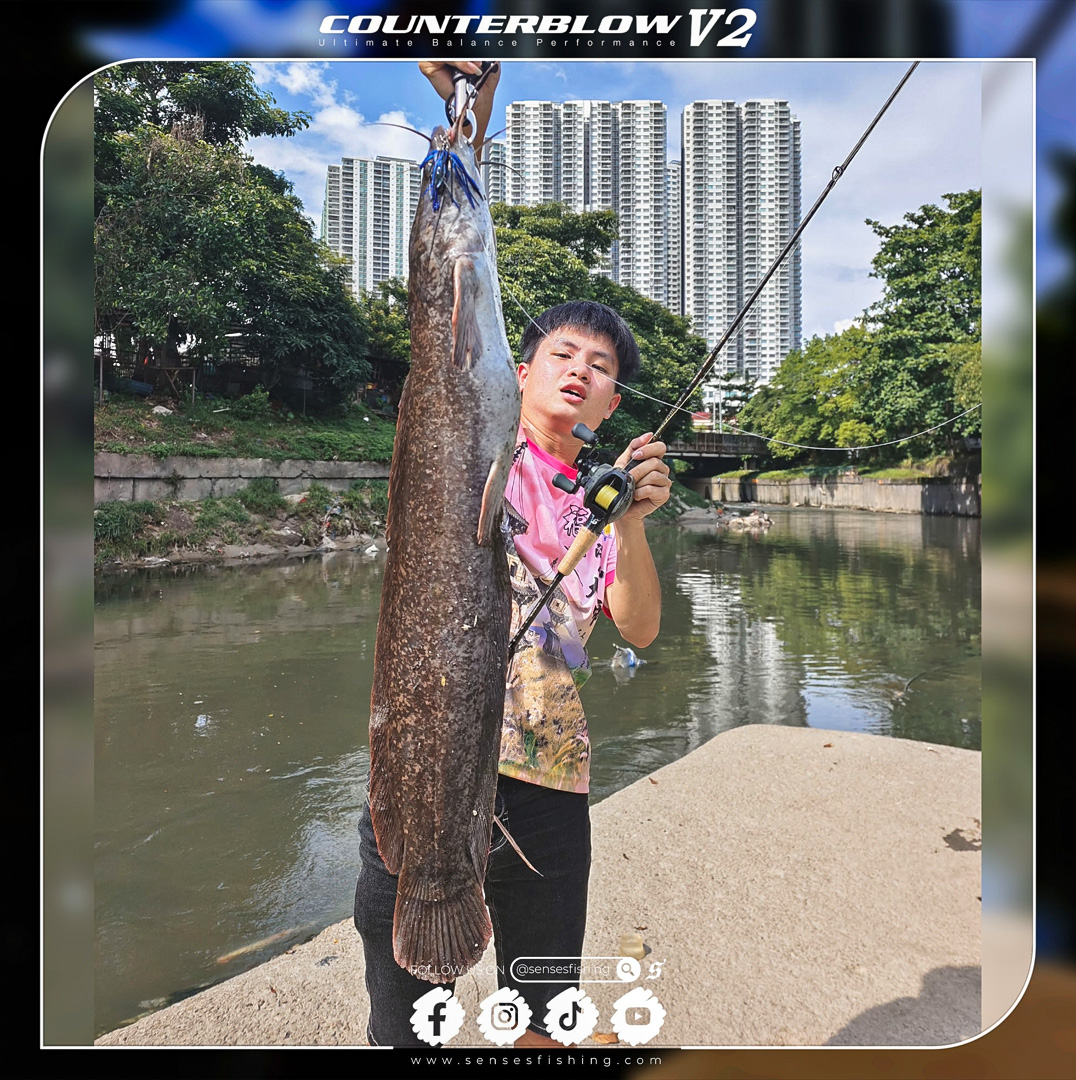

City Limits, No Limits: Pin Pin’s Counterblow V2 Victory 🏙️🏆
When you are standing on the edge of a bustling city canal, the margin for error is razor-thin. Senses Pro Angler Pin Pin knows that these urban waterways house "stealth giants"—predators that have survived by being cautious and powerful. To extract this monster, Pin Pin utilized a high-precision skipping technique, sending his lure deep into the shadows of the overhanging structures where these fish ambush their prey. The Senses Counterblow V2 was the MVP of this session; its fast action allowed for a lightning-quick hookset, while the reinforced blank provided the massive lifting power required to keep the fish from wrapping the line around submerged debris and sharp concrete pillars.
Landing a fish of this caliber in such a confined environment is a testament to the "Ultimate Balance Performance" of the Senses Counterblow V2. Pin Pin emphasizes that in urban angling, you don't just fight the fish; you fight the environment. The rod’s ergonomic grip and balanced weight distribution allowed him to maintain a steady pressure during the fish's violent headshakes and deep dives. For Pin Pin, the Counterblow V2 isn't just a rod—it's a specialized tool that turns a chaotic urban struggle into a controlled victory, proving that with the right gear, the city’s drainage systems can become a world-class fishing ground. 🎣🔥

The Fish: Giant Snakehead (Channa micropeltes)
Commonly known in Southeast Asia as the Toman, this is the largest and most aggressive member of the Channidae family.
Physical Characteristics:
• Size & Weight: This specimen appears to be in the "Heavyweight" class, likely exceeding 5–7kg. Its elongated, torpedo-shaped body is built for sudden, explosive bursts of speed.
• Apex Dentition: They possess a mouth full of backward-curving, razor-sharp teeth designed to grip slippery prey and even bite through standard fishing lines, which is why Senses Pro Angler Pin Pin relies on the heavy-duty backbone of the Senses Counterblow V2.
• Patterning: Note the dark, mottled "camo" pattern. In mature adults, this helps them blend into murky water and shadows. The "snake-like" scales on the head give the species its name.
• Labyrinth Organ: Unlike many fish, the Toman is an air-breather. It has a primitive lung-like organ that allows it to survive in low-oxygen (hypoxic) water, making it the king of stagnant urban canals.
The Habitat: Urban Drainage & Canal Systems
The backdrop of high-rise apartments and concrete embankments indicates a highly specialized "Urban Jungle" ecosystem.
Structure & Ambush Points:
• Concrete Ledges: The man-made "steps" and vertical walls create perfect ambush points. Toman will sit tight against the wall, waiting for baitfish to be pinned against the concrete.
• Submerged Debris: Urban canals often contain "snags" like discarded tires, shopping carts, or fallen timber. This is where the Senses Counterblow V2 rod becomes essential; you need the torque to "crane" the fish out before it can wrap your line around these hazards.
Water Conditions:
• Turbidity: The water is "murky" or "tea-colored." Visibility is low, which means the fish relies heavily on its lateral line system to sense vibrations. This is why Pin Pin likely used a lure with high vibration or a "noisy" skirted jig to get its attention.
• Thermoclines: In these shallow concrete basins, the water temperature can rise quickly. The fish will often hold in the deeper, cooler center channel or under the shade of bridges during the heat of the day.
Forage Base:
These canals are often teeming with Tilapia, Koi, and smaller catfish. The abundance of high-protein food in city waters allows the Toman to grow much faster and larger than their counterparts in some natural wild lakes.

Pro Tips
1. Equipment Strategy: The "Heavy Extraction" Setup
In an urban canal, you aren't just fighting a fish; you are fighting concrete, rebar, and debris. Your gear must be "overbuilt" for the task.
• The Rod (Senses Counterblow V2): * Why V2? You need a rod with a fast action but a heavy backbone. The Counterblow V2 is designed to absorb the initial "hammer strike" of a Toman while providing enough lifting power to "crane" a 5kg+ fish up a concrete bank.
> Tip Control: Use a rod length that allows for "underhand" or "sidearm" casts to get under low-hanging urban pipes or bridges.
• The Line & Leader: * Mainline: Use a high-quality 4-strand or 8-strand PE braid (PE 3.0 to 5.0).
> Shock Leader: Toman have razor-sharp teeth and canals have sharp concrete edges. Use a 40lb–60lb fluorocarbon leader. Fluorocarbon is more abrasion-resistant than mono when rubbing against canal walls.
• The Lure: * Skirted Jigs / Buzzbaits: In murky water, vibration is king. A skirted lure with a trailer creates a large profile and "thumping" sound that triggers the Toman’s lateral line.
2. Location Scouting: Reading the "Concrete Jungle"
Not all parts of a canal are equal. Senses Pro Angler Pin Pin looks for "High-Probability Zones":
• The Shadow Line: During the hot Malaysian sun, Toman hide in the shadows cast by bridges or high-rise buildings. Cast your lure into the dark and retrieve it into the light.
• Drain Inflows: Areas where smaller pipes drain into the main canal are oxygen-rich and attract baitfish. Big Toman will sit right at the mouth of these pipes.
• The Vertical Wall: Toman often "patrol" the concrete edge. Instead of casting far into the middle, cast parallel to the wall, keeping your lure within 12 inches of the concrete for the entire retrieve.
3. Professional Techniques by Pin Pin
Landing a fish this size requires more than just throwing a lure; it requires a tactical approach.
• The "Commotion" Cast: * Sometimes, splashing your lure hard on the surface actually attracts a Toman. It mimics a baitfish jumping in fear.
• The Hookset (The "Counterblow"): * Toman have extremely bony jaws. A "soft" hookset will result in the fish spitting the lure. When you feel the strike, perform a hard, vertical "Power Set." This is where the Senses Counterblow V2 shines—it doesn't "fold" under the pressure, ensuring the hook penetrates deep.
• The First 5 Seconds: * This is the "danger zone." A Toman’s first instinct is to dive into a snag. You must keep your rod tip high and use the reel’s drag to "bully" the fish toward the surface immediately. Do not give an inch of line if you are near a shopping cart or submerged debris.
• The "Figure-Eight" Finish: * When the fish is near the bank, it will often make one last violent "death lung." If the fish is still "green" (full of energy), swirl your rod tip in a figure-eight pattern in the water to keep the fish moving and prevent it from snapping the rod tip against the concrete ledge.
4. Safety & Ethics
• Lip Grips: As seen in the photo, Senses Pro Angler Pin Pin uses a high-quality lip grip. Never put your hands near a Toman's mouth; their bite can cause nerve damage.
• Catch & Release: To ensure our urban canals stay "alive" with these monsters for future generations, practice quick photos and safe releases.
The Proper Time
1. The Best Time: The "Oxygen & Light" Windows
Toman are diurnal (active during the day), but their peak aggression is tied to light transitions and water temperature.
• Primary Window (7:00 AM – 10:00 AM): This is the "Golden Hour." As the sun rises, baitfish move to the surface to feed, and Toman follow. The water is still cool, and the fish are willing to leave deep cover to strike topwater lures.
• Secondary Window (4:30 PM – 7:30 PM): As the urban heat begins to dissipate, Toman become active again. This is the best time for "Shadow Hunting"—casting the Senses Counterblow V2 into the long shadows cast by canal walls or buildings.
• The "Rising" Period (11:00 AM – 2:00 PM): While most anglers go to lunch, Pin Pin knows that the midday heat forces Toman to surface for air more frequently (using their labyrinth organ). This is the prime time for sight-casting to "risings" in the middle of the canal.
2. Ideal Weather: The "Pre-Storm" Surge
In Malaysia, weather shifts are the biggest trigger for Toman aggression.
• The "Low Pressure" Trigger: Toman are highly sensitive to barometric pressure. The 1-2 hours before a heavy tropical thunderstorm are often the most productive. The drop in pressure makes them "frenzy" feed.
• Overcast / Light Rain: Avoid high-noon blue skies if possible. Overcast conditions reduce the shadow of your line and rod on the water, making the fish less "spooky."
• Post-Rain Inflow: Right after a rain, the drainage "inflows" (pipes) dump fresh, oxygenated water into the canal. Toman will stack up at these points to ambush baitfish struggling in the new current.
3. The "Tidal" Secret in Urban Canals
Many people forget that urban canals in cities like Klang, JB, or Malacca are often tidally influenced by nearby river mouths.
• The Outgoing Tide (High to Low): This is the best time. As the water level drops, Toman are forced out of the shallow vegetation or "hidden" crevices and into the main deeper channel. They become concentrated and much easier to target with the Senses Counterblow V2.
• The "Slack" Water: When the tide is at its absolute lowest or highest and not moving, the bite often dies. You want moving water—this creates "current seams" where Toman sit and wait for food to be washed past them.
4. Choosing the "Hot Spot" (Place)
Senses Pro Angler Pin Pin looks for specific "Urban Micro-Habitats":
• The "Concrete Elbow": Any 90-degree turn in a canal creates a natural "eddy" (swirling water) where debris and baitfish collect. This is almost always home to a dominant territorial Toman.
• Submerged "Structure": Look for things that don't belong—sunken shopping carts, tires, or concrete slabs. These provide the "roof" a Toman needs to feel secure.
• The "Fry Ball" Zone: Between October and March, look for a "boiling" ball of tiny red fish on the surface. These are Toman fry. The parents (like the one in the photo) will be circling underneath, ready to attack anything that gets too close.
Pro Tip: If the water is very still and clear, use the Senses Counterblow V2 to make "Long Range" casts. Urban Toman are smart; if they see your silhouette on the canal bank, they won't strike.
Striped Snakehead


The Striped Snakehead ($Channa \ striata$), precisely known as the Haruan in Malaysia, is a highly resilient freshwater fish prized for both its sporting qualities and its medicinal properties.
Physical Characteristics
• Body Shape: It has an elongated, cylindrical body that tapers toward the tail, covered in cycloid scales.
• Head Structure: The head is flattened and snake-like (depressed), featuring large, shield-like scales on the top.
• Coloration: The dorsal (top) and lateral (side) areas are typically dark brown or blackish, while the belly is white.
• Side Markings: It is characterized by dark, oblique (diagonal) bars or "chevron" patterns that run downward and forward toward the belly.
• Belly Patterns: The underside often features small, irregular dark spots or "peppered" markings against the white background.
• Fins: It possesses a long dorsal fin and an anal fin that extend along a significant portion of the body, with a rounded caudal (tail) fin.
Habitat & Biology
• Air-Breathing: Like all members of the $Channidae$ family, it has a suprabranchial organ that allows it to breathe atmospheric air, enabling it to survive in low-oxygen waters or even out of water for short periods.
• Environment: It is commonly found in stagnant or slow-moving freshwater, such as ponds, canals, swamps, and rice paddies.
• Diet: It is a carnivorous ambush predator, feeding on smaller fish, frogs, insects, and crustaceans.
Angling & Cultural Significance
• Lure Fishing: It is highly responsive to topwater lures and subsurface lures like the chatterbait shown in your photos.
• Medicinal Use: In Southeast Asia, particularly Malaysia, the Haruan is famous for its perceived healing properties; it is often consumed post-surgery to aid in wound recovery due to its high amino acid and fatty acid content.
• Precision in Naming: It is distinct from the Giant Snakehead (Channa micropeltes, or Toman), which grows significantly larger and lacks the distinct chevron markings and peppered belly of the Channa striata.
Recommended Setup
To help you gear up like Senses Pro Angler Pin Pin, here is the ultimate urban setup and tactical breakdown using strictly Senses and ABX products.
1. The Recommended Rod Setup
Since we are looking beyond the Counterblow V2, we move to the next level of specialized urban tools designed for high-torque extraction.
• Rod: Senses Counterblow TR (Tune Revolution) CBTR-702H
> Power: Heavy (12–30lb line rating).
> Length: 7'0" (The ideal length for "long-distance accuracy" across wide canals while maintaining enough leverage to lift fish up high concrete banks).
> Tech: Features the Spiral Cross Carbon blank, which prevents the rod from twisting when a giant Toman dives under a concrete ledge.
• Mainline: Senses Mojiko (PE 4.0 or 5.0)
> Color: High-Visibility Green White or Multicolor (Crucial for tracking your line movement in murky canal water).
• Leader: Senses Absorber (50lb or 60lb)
> Property: High abrasion resistance. In the "Concrete Jungle," your leader will constantly rub against sharp cement edges; this fluorocarbon is designed to survive those scrapes.
• Hardware: ABX Diamond Snap (Size #2 or #3)
> Strength: Rated for 50lb+. Standard snaps will bend open during a Toman’s "death roll."
2. Strategic Lure Selection (Senses & ABX)
Toman in canals are territorial. Your lure needs to provoke a "get out of my space" reaction.
• Topwater (The Thrill): ABX Pencil 100
> Technique: Use a fast "Walk-the-Dog" retrieve. The internal steel rattles create a "clacking" sound that resonates against the canal walls, drawing Toman out from deep shadows.
• Sub-Surface (The Hunter): Senses Kaido Shad 76SS
> Technique: A slow-sinking lure. Cast parallel to the concrete wall and "twitch" it. This mimics a wounded Tilapia—the primary food source in urban drains.
• Deep Cover (The Extraction): Senses Digger 78F
> Technique: Use this near bridge pylons. The long lip allows it to "dig" deep and bounce off submerged shopping carts or debris without snagging the hooks.
3. The "Pin Pin" Technique: Step-by-Step
Landing a fish like the one in the photo requires a specific "Power Angling" approach:
• The Parallel Cast: Never cast into the middle of the canal first. Senses Pro Angler Pin Pin always casts parallel to the wall, keeping the lure in the "Strike Zone" (the 1-foot strip of shadow next to the concrete) for the entire retrieve.
• The Reaction Strike: If you see a Toman "rise" for air, immediately cast 2 meters behind the bubbles and retrieve the lure quickly over the spot.
• The Vertical Hookset: Because Toman have bony mouths, you must use the backbone of the Senses Counterblow TR to set the hook vertically (upward). Do not set the hook sideways in a narrow canal, or you risk hitting the concrete wall with your rod tip.
• The "No-Drag" Rule: In the urban jungle, "drag is your enemy." Tighten your reel drag almost to the limit. You must force the fish to the surface in the first 3 seconds before it can wrap your line around submerged urban junk.

♦ The SENSES Counterblow V3: Redefining Performance and Versatility ♦
The SENSES CounterBlow V3 is a highly sensitive baitcasting rod with a one-piece design, built for precision and durability.
Crafted with advanced Cross-X technology carbon tape in a multi-axis style, the CounterBlow V3 offers superior stability and exceptional handling in any fishing environment. Whether you’re targeting light strikes or preparing for a sudden big catch, this rod is designed to handle it all.
The SENSES CounterBlow V3 utilizes Fuji components. The Fuji Alconite K guide enhances casting performance, lifting power, and hook-setting efficiency, giving you better control with every cast. Unlike the V2, which uses the Fuji ACS reel seat, the CounterBlow V3 is now equipped with the Fuji PMTS reel seat, providing a more secure grip, improving sensitivity, and ensuring a better connection between you, the rod, and the fish.
The overall design features black, red, and gold accents, giving the CounterBlow V3 a noble and mysterious feel that enhances your fishing experience. It is also equipped with a new 3D SENSES logo plate at the bottom of the rod, adding a unique touch of style and elegance.
Each rod is specifically designed to meet the demands of today’s top fishing techniques, making casting effortless and offering the sensitivity to feel even the lightest strikes. The CounterBlow V3 is the perfect rod for any serious angler seeking ultimate performance.

Introducing the SENSES Long-Sleeve Jersey - the epitome of high-quality craftsmanship and comfort for all your athletic pursuits! Designed with precision printing and sewing, this jersey ensures an exceptional level of detail and durability, making it your go-to choice for any activity. With its unisex cutting, it caters to all athletes, providing a perfect fit for everyone. Crafted from fast-drying, moisture-absorbing, and sweat-extracting fabrics, it offers unparalleled performance and longevity, keeping you cool and dry throughout your everyday activities. Elevate your sportswear collection with the Senses Long-Sleeve Jersey - the ultimate blend of style, functionality, and endurance, ready to accompany you on every step of your fitness journey!
Click on any of the items listed below to find out more on the product page:
Angler: Senses Pro Angler Pin Pin
Apparel: Senses Long-Sleeve Jersey - Blue Dragon