
 0
0  Login
Login 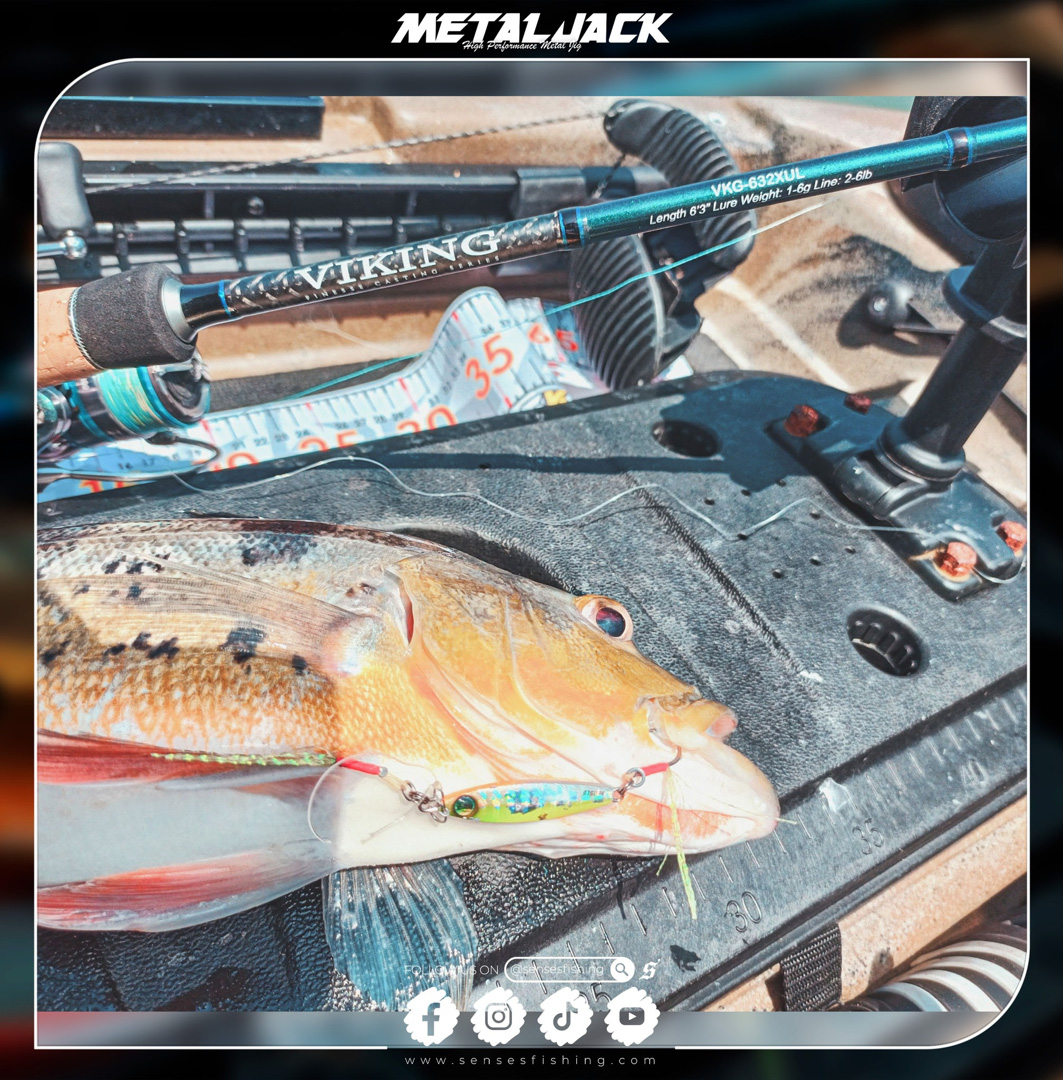

Vibrance and Valor in the Deep
When Senses Pro Angler Mat Fared hits the water, he brings a level of technical expertise that turns a standard fishing trip into a masterclass. Operating from a stealthy kayak setup, he utilizes the Senses Viking rod to navigate the tight structure and overhanging branches that characterize the Peacock Bass’s natural habitat. The Senses Viking is the ultimate extension of the angler’s arm, offering the light-tackle finesse needed to work small lures while maintaining enough power to pull a fighting fish away from snag-heavy cover. It’s a delicate balance that Mat Fared has perfected through countless hours on the water ✨.
The star of the show, the Senses Metal Jack, proved its worth once again by cutting through the water column with unmatched agility. Mat Fared’s technique involves a "stop-and-go" retrieve, allowing the jig to flutter vertically, which triggers the predatory instinct of the fish. As the Peacock Bass lunged for the Senses Metal Jack, the hook-up was instantaneous thanks to the rod’s responsive blank. Seeing the vibrant yellows and blacks of the fish against the backdrop of the lake is a reward that only comes to those who trust their gear and their instincts as much as Mat Fared does 🐟.


To truly understand the success of Senses Pro Angler Mat Fared, one must look at the specific biology of the target and the specialized engineering of the gear. Here is a detailed breakdown of the Peacock Bass habitat and the technical specifications of the equipment used in that photograph.
1. Physical Characteristics: The Tropical Emperor
• Head and Mouth: The Peacock Bass features a powerful protractile mouth with a protruding lower jaw. It possesses rows of villiform teeth (fine, sandpaper-like needles) designed to grip prey securely. Mature males are distinguished by a nuchal hump, a fatty forehead deposit used to signal dominance during breeding.
• Coloration and Markings: Known for its vibrant "Golden-Green" hue, its body is marked by three bold black vertical bars. Its most iconic feature is the ocellus (eye-spot) on the tail, a defensive mimicry used to confuse predators and protect its real head from strikes.
• Body and Fins: It has a deep, muscular profile built for high-torque bursts. The broad caudal fin (tail) acts like a paddle, providing the explosive "hole-shot" speed required to ambush fast-moving baitfish in dense cover.
2. Habitat: The "Structure-King" of the Reservoir
• Lentic Environments: Unlike the current-loving Goonch, the Peacock Bass thrives in the still, warm waters of reservoirs and mining pools. They are thermophilic, meaning their metabolism and aggression levels peak when the water is heated by the tropical sun.
• Ambush Zones: They are strictly structure-oriented, lurking in the shadows of submerged timber, lily pads, and rocky drop-offs. They utilize these "pockets" to remain invisible to prey while maintaining a tactical advantage for a sudden strike.
• Water Quality: They prefer clear to tea-colored water with high oxygen levels. They are highly visual hunters, relying on water clarity to spot the shimmer of a lure like the Senses Metal Jack from a distance.
3. Behavior and Equipment
• The Vacuum Strike: This predator feeds by rapidly expanding its oral cavity, creating a vacuum that inhales the prey. This happens in milliseconds, often producing a distinct "popping" sound on the surface.
• Equipment Synergy: To counter this, Senses Pro Angler Mat Fared uses the Senses Viking rod—an ultra-light tool with a crisp, fast action that allows for an instantaneous hook-set. The Senses Metal Jack jig is worked with a "twitch-and-drop" technique; its asymmetrical body creates a hypnotic flutter on the sink that mimics a dying fry.
• Conservation: Mat Fared utilizes the Senses Pro Angler Mat to protect the fish's delicate slime coat and scales during measurement, ensuring a healthy release for this prized game fish 🎣.


Pro Tips
To master the art of targeting Peacock Bass with the specific gear used by Senses Pro Angler Mat Fared, you need to blend stealth with high-speed technical precision.
1. The Fish: Peacock Bass (Ikan Raja)
• The "Double-Tap" Strike: Peacock Bass often hit a lure twice—first to stun it, then to inhale it. If you feel a "bump" but no weight, do not stop. Keep the lure moving or give it a sharp twitch; this mimics a wounded fish trying to escape and will trigger the final, aggressive swallow.
• Target the "Fry-Ball": If you see a cluster of tiny fish shimmering on the surface, the parents are likely circling beneath. Cast your Senses Metal Jack past the school and retrieve it through the outskirts. The parents will strike out of pure territorial protection.
• Sun is Your Friend: Unlike most fish that hide at noon, Peacock Bass metabolism peaks in high heat. Fish the brightest part of the day (11:00 AM – 3:00 PM) for the most aggressive surface and mid-water action.
2. The Place: Reservoirs & Mining Pools
• Identify the "Kill Zone": Look for thermal edges—where shallow, sun-warmed water meets a deep, cool drop-off. Peacock Bass sit in the cooler deep water and launch "raids" into the shallows. Position your kayak in the deep and cast toward the bank.
• Shadow Management: Always keep the sun in front of you or to the side. If your kayak casts a long shadow over a "pocket" of submerged timber, the fish will spook before you even make a cast.
• Stealth Approach: In Malaysian reservoirs, the water is often still. Use your paddle sparingly; the "slap" of a paddle on the surface can shut down a bite for 15 minutes. Use the wind to drift into casting range of lily pads.
3. Equipment: Senses Viking & Metal Jack
• The "Slack-Line" Flutter: When using the Senses Metal Jack, the "kill" happens on the fall. After you twitch the rod tip up with the Senses Viking, immediately drop the tip to give the line a bit of slack. This allows the jig to dance and spiral naturally rather than being pulled in a straight line by the tension.
• High-Speed Burn: If the fish are following but not biting, use the Senses Viking’s fast recovery to "burn" the jig. Reel as fast as possible for 5 meters, then dead-stop. The sudden change in velocity often forces a "reaction strike."
• Drag Calibration: Because the Senses Viking is a finesse rod, set your reel drag to about 25-30% of your line's breaking strain. Peacock Bass have a hard "first run," and a drag that is too tight will result in a snapped leader or straightened hooks on the Metal Jack.
• Landing Technique: Always use a landing net or the Senses Pro Angler Mat. Lifting a heavy Bass by the lower jaw (vertical hang) can damage its internal organs and vertebrae. Support the belly to ensure a healthy release.
The proper time & place
I. Best Time: The "Peak Heat" Window
Peacock Bass are cold-blooded and tropical. Their metabolism and hunting aggression are directly tied to water temperature.
• Primary Window (10:00 AM – 3:00 PM): While most anglers go home when the sun gets hot, this is when Peacock Bass are most active. High sun provides the best visibility for them to see the flash of your Senses Metal Jack.
• The "Fry-Feeding" Hour (7:30 AM – 9:00 AM): This is when they herd baitfish toward the shallows. You will see surface "boils" or "explosions." Use a faster retrieve during this time.
• Avoid Night Fishing: Peacock Bass are strictly diurnal (daytime) hunters. They have poor night vision compared to Catfish or Barramundi, so fishing for them in total darkness is rarely productive.
II. Weather: The "Bright & Still" Factor
• Sky Condition (Clear/Sunny): Full sun is 100% the best weather. It creates sharp shadows in the structures where they hide and maximizes the "strobe effect" of your metal jig.
• Wind (Low/Light Breeze): Peacock Bass are easily spooked by surface vibrations. A "glassy" water surface or a very light ripple is ideal. High wind makes it difficult to control a light kayak and dampens the sensitivity of the Senses Viking rod.
• Barometric Pressure: They are most active during a stable or rising barometer. If a heavy tropical monsoon rain is approaching (falling pressure), the bite will often "shut off" completely.
III. Place: Finding the "Honey Hole"
• The "Drop-Off" Edge: Look for areas where a shallow flat (1m depth) suddenly drops into deep water (4m+). The Bass sit in the deep and look upward for prey crossing the shallow ledge.
• Concrete & Rock: Man-made structures like bridge pilings, dam walls, and intake towers are heat-magnets. They retain sun warmth and provide the vertical structure these fish love.
• Submerged "Forests": In reservoirs like Air Kuning or Chenderoh, look for "dead trees" sticking out of the water. Cast your Metal Jack as close to the trunk as possible.
• Pockets in Vegetation: Look for small gaps in lily pads or hydrilla. These "pockets" act like chimneys—the fish sit at the bottom and strike anything that falls through the gap.
IV. Tide: The "Freshwater Influence"
Since Peacock Bass are freshwater fish, they are not affected by ocean tides. However, they are affected by "Water Movement":
• Inflow Points: After a light rain, look for pipes or small streams flowing into the main reservoir. This moving water is highly oxygenated and carries insects/fry. This acts exactly like a "high tide" for freshwater fish, triggering a feeding frenzy.
• Floodgate Operations: If you are fishing near a dam, the moment the gates open and the water begins to move/circulate, the Peacock Bass will turn on. They love the "aerated" water caused by movement.
• Water Level (Rising vs. Falling): A slowly rising water level is best, as it pushes the Bass into the newly flooded grass and timber to hunt for insects and displaced fry.
Nile Tilapia
The Nile Tilapia (Oreochromis niloticus), widely recognized as the St. Peter's Fish & Ikan Tilapia, represents a resilient and territorial titan of tropical freshwater systems. While it shares the cichlid lineage and aggressive defensive instincts of the Peacock Bass (Cichla) targeted by Senses Pro Angler Mat Fared, the Nile Tilapia is a master of the littoral zone—an environment defined by heavy structure, nesting colonies, and extreme environmental endurance. Unlike the nomadic, open-water pursuit of the White Bass, the Nile Tilapia is a localized, structure-bound guardian that relies on burst speed and fierce territoriality to dominate its murky domain. Understanding this species requires a look into its "Tank-like" physiology and its preference for warm, shallow habitats where its defensive nature makes it a challenging target for finesse anglers.
1. Physical Characteristics: The St. Peter's Cichlid
• Head and Mouth: The Nile Tilapia features a blunt, powerful head with thick, fleshy lips and a terminal mouth. Unlike the sandpaper teeth of the White Bass, it possesses specialized pharyngeal teeth in the throat and bicuspid teeth for grazing on algae and small invertebrates.
• Body and Armor: It has a deep, laterally compressed, oval-shaped body built for stability. It is armored with coarse ctenoid scales and a long, continuous dorsal fin featuring 15–18 sharp hard spines—a formidable defense against larger river predators.
• Coloration: The body typically displays a silver-to-bronze sheen with distinct vertical bars along the flanks. The most precise identifier is the pattern of regular dark stripes on the caudal (tail) fin, which helps it break up its silhouette against muddy bottoms.
• Fins: It possesses a truncate (square) caudal fin. While this tail lacks the long-distance stamina of a forked tail, it provides the massive burst power necessary for darting into thick cover or launching a lightning-fast territorial strike.
2. Habitat: The Resilient Specialist
• Littoral and Benthic Zones: Unlike the pelagic White Bass, Nile Tilapia are structure-oriented and stay within the "littoral zone" (shallows). They prefer the edges of lakes and rivers, often found near fallen timber, reed beds, or submerged vegetation.
• Mouthbrooding and Nesting: During spawning, males sweep out circular nests in the sand. The Nile Tilapia is a maternal mouthbrooder; the female carries the eggs and fry in her mouth for protection, ensuring high survival rates in predator-dense waters.
• Environmental Resilience: They are "extremophiles" that thrive in water temperatures between 20°C and 32°C. They are highly tolerant of low dissolved oxygen and varying salinity levels, thriving in environments that would be lethal to more sensitive temperate species.
3. Behavior and Technique
• Territorial Guardians: Nile Tilapia are not schooling hunters in the open water; they are colony-based defenders. They will aggressively "bump" or strike at intruders that enter their nesting territory to protect their young.
• Opportunistic Aggression: While primarily herbivorous or detritivorous, they exhibit high levels of aggression toward small fish or lures that mimic egg-thieves.
• Technique with Senses Gear: For Nile Tilapia, Mat Fared would pivot from high-speed retrieves to a "Bottom Tapping" or "Micro-Jigging" technique. Using the Senses Metal Jack 8g (as seen in the catch), he would cast near nesting pockets or submerged structure. The key is a slow, "hopping" retrieve—allowing the jig to bounce off the bottom to trigger a territorial snap strike from a defending adult.

Pro Tips
1. The Fish: White Bass Techniques
• The "Surface Boil" Interception: When White Bass corral shad at the surface, they create a visible "boil." Cast your Senses Metal Jack to the edges of the commotion rather than the center; the larger, more aggressive fish often patrol the perimeter to catch "crippled" baitfish escaping the pack.
• Vertical "Yo-Yoing": If fish are holding deep (detected on sonar), drop the Senses Metal Jack to the bottom and "rip" it upward 2–3 meters, then let it flutter back down on a semi-slack line. The Senses Viking rod is essential here to feel the "tick" of a strike during the descent.
• Speed is Key: White Bass are high-energy predators. If they are following but not committing, increase your retrieve speed. A "burning" retrieve with the Senses Viking creates a flight response in the fish, forcing them to strike before the "prey" escapes.
2. The Place: Strategic Locations
• River Inflow & Tailwaters: During the spring spawning run, White Bass congregate in massive numbers below dams and in river mouth inflows. Target the eddies (swirling water) just outside the main current, as fish sit there to conserve energy while waiting for food to wash downstream.
• Underwater Humps & Points: In large reservoirs, search for submerged "islands" or points that extend into deep water. White Bass use these as "fences" to trap schools of shad. Focus your efforts on the windward side of these structures, where plankton and baitfish are pushed by the breeze.
• The "Birds are Spotters" Rule: In open water, look for diving gulls or terns. Birds are the best indicator of a White Bass school pushing baitfish to the surface. Position your boat or kayak upwind and drift silently into casting range.
3. The Equipment: Senses Viking & Metal Jack Optimization
• The Senses Viking (Rod): For White Bass, you need a rod that can launch light lures long distances. The Senses Viking provides the tip speed necessary to "fling" a 7g–12g Metal Jack into a feeding frenzy without spooking the school with your boat’s hull.
• The Senses Metal Jack (Lure): Use the silver or "chrome" patterns to mimic the high-reflectivity of Gizzard Shad or Threadfin Shad.
> Pro Tip: Replace the tail treble with a single Senses Assist Hook on the head. This prevents the lure from getting fouled in the fish’s gill plates during the chaotic "pack" strikes common with this species.
• Line Choice: Use a thin PE 0.6 – 1.0 braided line paired with a 10lb – 12lb Senses Fluorocarbon leader. The thin diameter allows the Senses Metal Jack to sink faster and cut through the wind during those long-distance open-water casts.
The Proper Time & Place
I. Best Time: The "Light Transition" Windows
White Bass have excellent low-light vision, which they use to ambush disoriented baitfish.
• Dawn and Dusk (Prime Time): The 60-minute windows around sunrise and sunset are the most productive. During these times, the "Silver Stripers" push baitfish to the surface in massive "boils," making them easy targets for the Senses Metal Jack.
• Mid-Morning "Sun-Up": Once the sun is high, White Bass often move deeper (3m–6m). This is the best time for Mat Fared to use the Senses Viking for vertical jigging over underwater humps.
• Seasonal Timing: Spring is the absolute peak. As water temperatures hit 12°C to 15°C, they begin their massive spawning runs into tributary rivers.
II. Weather: The "Wind and Cloud" Factor
• The "Windy Shore" Effect: Look for shorelines or points where the wind is blowing toward the land. Wind pushes plankton, which draws in shad, which inevitably brings the White Bass.
• Overcast Skies: On cloudy days, White Bass will stay near the surface longer because they feel less exposed to overhead predators. This extends the "topwater" or "shallow jigging" window significantly.
• Approaching Fronts: Fishing just before a storm (falling barometric pressure) often triggers a frantic feeding state. However, once the "cold front" passes and the sky turns bright blue, the fish usually dive deep and become lethargic.
III. Place: The "Pelagic Highway"
• River Mouths and Tailwaters: During the spring, focus on the turbulent water below dams or where a creek enters a large lake. White Bass love the oxygen-rich, moving water.
• Submerged Humps and Islands: In large reservoirs, White Bass use underwater "mountains" to trap schools of shad. They will sit on the down-current side of the hump to wait for prey to be swept over the top.
• Open Water Basins: During summer, they roam the "flats" (large areas of uniform depth). Look for diving birds—if you see gulls diving, there is a school of White Bass beneath them.
IV. Tide: The "Current" Equivalent
While White Bass are primarily freshwater fish, they are highly rheophilic (current-loving). In a reservoir, "tide" is replaced by water flow:
• Power Generation Cycles: At many dams, "tide" is created when the turbines start. When the water begins to flow, White Bass "turn on" almost instantly. The movement disorients baitfish and activates the predators.
• Wind-Driven Currents: In very large lakes, a strong, sustained wind creates a "seiche" or internal current. This mimics a tidal flow, pushing schools of fish toward specific points and bottle-necks.
• The Inflow Surge: A rising water level after a rain serves as a biological "high tide," signaling the fish to push further up into the rivers for spawning or feeding on displaced insects.
Recommended Setup
Peacock Bass: The "Structure Sniper" Setup
This setup is engineered for "close-quarters" combat in Malaysian reservoirs. It requires a rod with high-modulus recovery to stop a Bass from "diving" into submerged roots and a lure that can navigate snag-heavy zones.
1. Rod: Senses Blackhell (Baitcasting)
Model: BHC-632M (6-15lb Line Rating) or BHC-602ML (4-12lb).
> Technical Detail: The Blackhell is the true "Structure Sniper." Unlike lighter rods, it is built with Japanese Toray 30+40 Ton high-carbon blanks. This creates a "stiff but light" action with an incredibly fast recovery rate. The 6'0" or 6'3" length is specifically designed for the "Pitching and Flipping" technique used to drop lures into tiny gaps in submerged timber with surgical accuracy.
2. Lure: Senses Nano Shad 62F (Floating)
> Specs: 62mm / 7.7g.
> Technique: This is a high-buoyancy jerkbait. Because it floats rapidly, it is perfect for "snag-walking." When the lure hits a submerged branch, you simply pause; the 62F will float backward and upward away from the snag. Twitch it aggressively to produce a high-pitched rattle that triggers territorial strikes.
3. Alternative Lure: Senses Kaido Shad 65HS (Heavy Sinking)
> Specs: 65mm / 11g.
> Technique: When Bass move to the deeper base of "stumps" or rocky ledges (2m–3m depth), the 65HS is the tool. It features a fixed weight system for a stable, vibrating descent that stays in the strike zone longer than lighter minnows.
4. Line: Senses Mojiko PE X8 Braid
> Specs: PE 1.5 (25lb).
> Logic: You need zero stretch to feel the "vacuum strike" and enough strength to physically "manhandle" the fish out of the snags before it wraps your line around a branch.
5. Snap: ABX Banana Snap (Stainless Steel)
> Detail: The wide-angle curve of the Banana Snap is critical for the Nano Shad. It provides more room for the lure’s eyelet to pivot, resulting in a much wider, more erratic "side-to-side" darting action during twitches.
6. Maintenance: ABX High Speed Bearing Oil
> Detail: Essential for baitcasting reels used for Peacock Bass. A drop on the spool bearings allows for the low-inertia "finesse" casts required to launch the 7.7g Nano Shad accurately.
7. Protection: Senses Reel Pouch
> Detail: Protects the high-end components of your setup from the abrasive dust and moisture found in jungle reservoirs.
White Bass: The "Open Water Pursuit" Setup
Targeting nomadic, schooling fish requires a setup that prioritizes long-distance casting to reach "boils" and high-response lures that can handle fast retrieves.
1. Rod: Senses Blue Horizon III (Spinning)
> Model: BHP-73ML (7'3") or BHP-79M (7'9")
> Technical Detail: The Spyker was a lightweight freshwater rod; the Blue Horizon series is the true distance king. Built with Japanese Toray 36-Ton advanced carbon and a 3-axis weave, it’s designed for "Light Challenge" offshore and open-reservoir casting. It can launch lures from 40g up to 80g (depending on the model) far beyond the splash zone of your boat.
2. Lure: Senses Kaido Shad 76SS (Sinking)
> Specs: 76mm / 21g
> Technique: Unlike the 65SP which is a lighter suspending jerkbait, the 76SS is a heavier sinking model. This is critical for White Bass because it allows you to cast into the wind and reach fish that have dived deeper after a surface boil. Its tight wiggling action remains stable even at the high speeds required for schooling predators.
3. Deep-Schooling Lure: Senses Candy Sardinia 2
> Specs: Varies (e.g., 20g–40g)
> Technique: When fish are holding deep, you need the aerodynamic profile of the Candy Metal Bait. It isn't a traditional jig; it's a metal vibe/casting lure that mimics the high-flash profile of a panicked shad or sardine. It sinks faster than a plastic shad and produces a high-frequency vibration that schools can "feel" through their lateral lines.
4. Alternative Deep Tool: ABX Jig Head
> Specs: AJH/1/0 (3.5g) or AJH/8/4G (4g)
> Technique: If you prefer soft plastics, the ABX Jig Head features a needle-point forged hook for instant penetration. The "anti-slide" design ensures your soft lure stays perfectly positioned during the violent strikes of a schooling White Bass.
5. Leader: Senses Jigger Assist PE Line (100lb - 150lb) or a high-grade Fluorocarbon. If you are targeting fish with abrasive mouths or near rough water, this assist line is extremely resistant to cutting.
6. Connection: Senses Stainless Steel Power Split Ring + Senses Speedy Rolling Swivel. This combo prevents line twist during the high-speed retrieves necessary for White Bass.

Gear up for a legendary fishing experience with the SENSES Viking model fishing rods. Meticulously crafted using the finest materials, these rods are designed to elevate your angling prowess to new heights. Prepare to embark on epic fishing adventures with the ultimate combination of power, durability, and comfort.
Equipped with the renowned Fuji VSS Reel Seat and Fuji Alconite K guides, the Viking model guarantees top-notch quality and performance. The Fuji VSS Reel Seat ensures a secure and reliable attachment for your reel, allowing for seamless operation and enhanced control. The Fuji Alconite K guides provide smooth line flow, reduced friction, and exceptional durability, resulting in longer and more accurate casts.
Crafted using 100% Toray Japan material, including Toray carbon tape and Toray carbon cloth, the Viking model boasts unparalleled strength and lightweight characteristics. Its unique 2-direction spiral wrapping enhances the rod's structural integrity and responsiveness, providing you with the power to conquer even the toughest catches. The spigot joint design further enhances the rod's strength and sensitivity, enabling you to feel every subtle movement beneath the water's surface.
Comfort is key during long fishing sessions, and the Viking model delivers on this front as well. The comfortable EVA rod butt ensures a firm and comfortable grip, reducing fatigue and allowing you to focus on the thrill of the catch. The cork + EVA split handle grip adds an extra touch of sophistication, providing a luxurious feel and enhanced control over your rod.
Whether you're a seasoned angler or just starting your fishing journey, the SENSES Viking Fishing Rod is your trusted companion. Get ready to unleash your inner warrior and conquer the waters with precision and power. Elevate your fishing game and embrace the spirit of the Viking with the SENSES Viking model fishing rods.

The SENSES Metal Jack Jig - the ultimate fishing companion designed to take your angling experience to new heights! Crafted with cutting-edge features, this jig is sure to become your go-to choice for various fishing techniques. Constructed from high-quality metal alloy material, the SENSES Metal Jack Jig boasts unmatched durability, ensuring it can withstand the toughest of challenges while maintaining its performance. The hologram body adds a touch of allure, attracting fish from afar with its mesmerizing glimmer.
Versatility is the key highlight of this jig. Whether you're into micro and light jigging or prefer casting and retrieving, the SENSES Metal Jack Jig adapts effortlessly to every fishing style. With its unique design, one side flaunts an intricate fish pattern, while the other side resembling a squid adds an extra layer of intrigue. The clever positioning of a big red-eye at the center confuses predator fish, dramatically increasing the hit rate.
The jig's surface treatment process ensures minimal flaws and superior painting, resulting in an impeccably smooth finish. This not only enhances its appearance but also contributes to its overall efficiency in attracting fish. Whether you're targeting fish at the top, middle, or bottom of the sea, the SENSES Metal Jack Jig is designed to excel in any fishing spot.
Unleash the potential of your fishing expeditions with the SENSES Metal Jack Jig and experience the thrill of breaking your personal target fish records. Don't miss out on the chance to elevate your fishing game and make every fishing trip a memorable success!
Click on any of the items listed below to find out more on the product page:
Angler: Senses Pro Angler Mat Fared
Rod: Senses Viking
Jig: Senses Metal Jack 8G
Apparel: Senses Fishing 10th Anniversary Ultron Jersey